
Is there a Santa Claus?
This blog first appeared on the BCYS site in December 2016
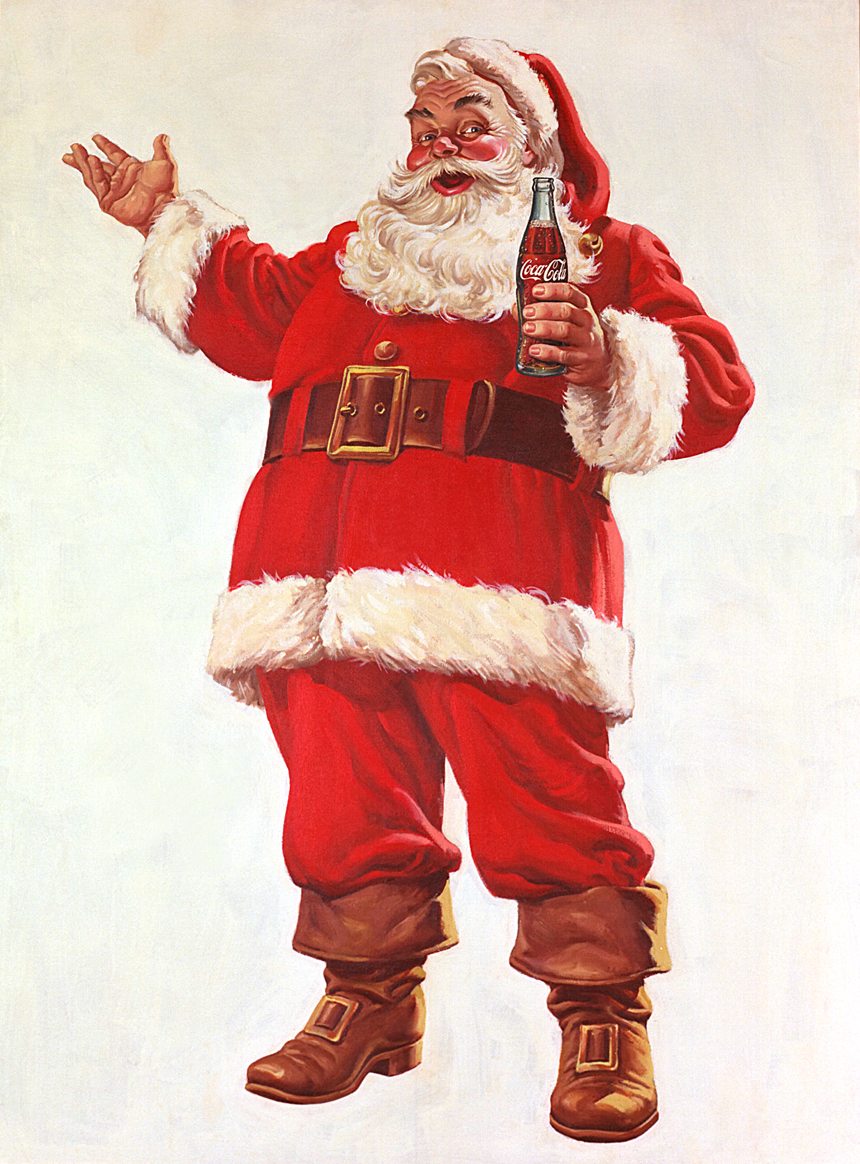
For some, the start of Christmas is when they first see the Coca Cola Christmas truck on the television. A real truck now visits towns around the UK over Christmas adorned with a huge image of Father Christmas on the side. It is often claimed that this isn’t anywhere close to the real St Nicholas, but a character largely created by Coca Cola to aid their commercial pursuits over the festive period. What is the truth in the story of a transformation from Turkish Bishop to a gift bearer from the North Pole?
Who was the real St Nicholas?
Sadly there is a lack of much historical evidence. However tradition suggests he was born in Patara, in Asia Minor and his family were wealthy; he was given a good Christian upbringing. His parents died while he was young, so St Nicholas became a priest and decided to use his inheritance for good and the benefit of others.
He was later ordained as a bishop with many stories told about his holiness and generosity - both of wealth and spirit. Some suggest he was imprisoned and tortured by Emperor Diocletian, others that he attended the Council of Nicea after being freed. One tale tells of how he intervened to spare three innocent men sentenced to death by a corrupt governor. St Nicholas confronted him and moved the governor to do penance. A popular story in the Middle Ages suggested that St Nicholas entered an inn whose innkeeper had just murdered three boys and pickled their dismembered bodies in barrels in the basement. The bishop not only sensed the crime had taken place, but resurrected the victims as well.
Perhaps the most famous story is how he helped a widower with three daughters. To save the girls from being sold into prostitution, St Nicholas tossed bags of gold through the window over three consecutive nights. He became the patron saint of both children and gift-giving.
Sources suggest he died at some point between 345 and 352 AD on December 6th, and was buried in his cathedral. However during later persecution of Christianity, his body was taken by Italian merchants in 1087 and reburied in a new church in Bari, Italy. His remains were used to reconstruct his face in 2014:

What happened between the 4th Century and today?
By the Middle Ages, St Nicholas was an incredibly popular Saint and from around 1200 to 1500 he was the undisputed bringer of gifts. Celebrations were centered around his Feast Day, December 6th. He had taken on some aspects of earlier European deities such as Saturn and Odin: white bearded men who had magical powers such as flight. Children were told to be good and say their prayers in order to get presents from St Nicholas.
The Protestant Reformation meant St Nicholas became far less popular. Dutch Protestants wanted to remove all Catholic links and renamed him Sint Klaes, which later became Santa Claus. They stripped him of his bishop's regalia and made him look more Nordic with a red suit.
Gift giving was moved to Christmas and linked to the infant Jesus instead. However as a baby, he was not able to deliver many presents, nor scare children into behaving. As such, Jesus was often given a scary helper to do this part of the job - it didn’t seem right to have baby Jesus threatening other young children!
These scary Germanic characters were given various names such as Ru-klaus (Rough Nicholas), Aschenklas (Ashy Nicholas), and Pelznickel (Furry Nicholas). The worst was perhaps Krampus: a half-goat, half-demon, horrific beast who literally beat children into being nice and not naughty. Good children got sweets, ‘wicked’ children got dragged off to his lair to be chained and whipped.

The Dutch brought Sinterklaas with them as they travelled the Atlantic and settled in America. Yet the celebrating of Christmas was largely shunned in New England as it had become an outdoor, alcohol-fuelled, rowdy community blowout with no particular magical gift bringer. Things were much the same back in Europe.
Saving St Nicholas
Christmas was to be saved by a series of authors and poets in the early 1800’s. They wanted a return to the family celebration and to revive the legend of the original St Nicholas.
Washington Irving's book Knickerbocker's History of New York (1809) first portrayed the pipe-smoking St Nicholas flying over the rooftops in a wagon. He delivered sweets and presents to good children and switches (sticks) to bad ones.
An anonymous illustrated poem called The Children’s Friend (1821) portrayed a much more familiar image of Santa Claus and linked him with Christmas. Notably, there was no return to any religious connections in this portrayal of St Nicholas. It is the first instance of him with a reindeer:
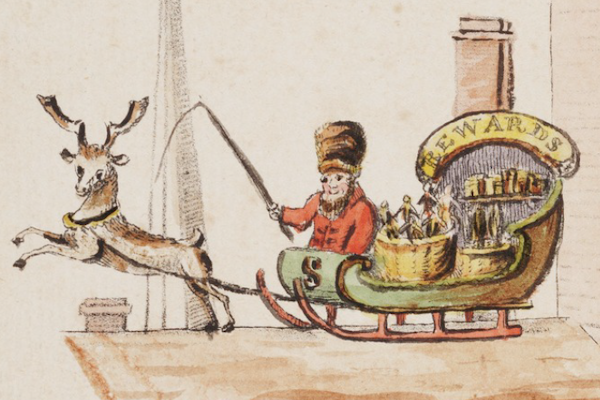
The following year, Clement Clarke Moore wrote A Visit From St. Nicholas, more commonly known as The Night Before Christmas, for his own children. Despite its anonymous publication, the book became hugely popular and further developed the image of Santa Claus. In the book, he was plump, jolly and had eight reindeer.
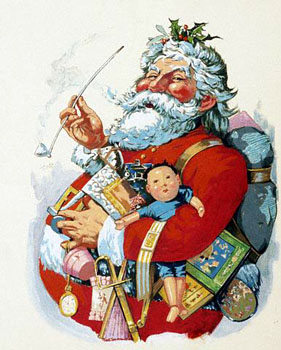
Despite a variety of different versions of Santa being found during the remainder of the 1800s, by the end of the 19th century, his recognisable image had been fully established. He was an older man, dressed in red and fur, who lived at the North Pole and had a sleigh driven by reindeer. Cartoonist Thomas Nast (1882) is credited with the jolly, chubby, grandfatherly like face:
North America’s Santa Claus, then did a reverse migration to replace the scary gift bringers. He adopted local names such as Père Noël (France) or Father Christmas (Great Britain) but the image was largely the same.
Of course, Haddom Sundblom, an advertising artist for Coca-Cola (1931-1965), ensured Santa Claus would always be known as the red-suited, larger-than-life, Coke-drinking jolly character found on the side of the Coca-Cola Christmas truck. It is this image that has grown over the last 150 years and remains popular with both children and adults today.
Some countries have resisted this image, and have anti-Santa movements. This is either trying to keep their own traditions alive, or trying to return to a more religious celebration of Christmas.
A young girl called Virginia wrote to the New York Times 1897 to ask, “Is there a Santa Claus?”. The editor replied:
"Yes, Virginia, there is a Santa Claus. He exists as certainly as love and generosity and devotion exist, and you know that they abound and give to your life its highest beauty and joy. Alas! How dreary would be the world if there were no Santa Claus! It would be as dreary as if there were no Virginias. There would be no childlike faith then, no poetry, no romance to make tolerable this existence. We should have no enjoyment, except in sense and sight. The external light with which childhood fills the world would be extinguished.... Nobody sees Santa Claus but that is no sign that there is no Santa Claus. The most real things in the world are those that neither children nor men can see.... Thank God! He lives, and he lives forever."
This certainly reads like a testament to the original St Nicholas. He continues to bring joy, generosity, kindness, love and excitement into our Christmas. For that, we should be incredibly grateful.
St Nicholas, pray for us.


