The new GCSE and A-Levels have caused great anxiety to many staff. The climate has changed since the last changes (2009 and 2008 respectively) whereby there is greater accountability, greater focus on exams (and technique), greater use of data, the introduction of performance related pay, more in depth exam analysis, ALPS, RAISE... all of these things necessitate changes to the class room teachers approach to Key Stage 4 and 5 teaching. Teachers are demanding more SAMs - but so are the students! A few comments / emails that I've had from my own students, with no prompting I hasten to add:
"Sir, how can there only be one SAMs? We need a bank of possible questions to practice." [GCSE Student]
"Will there be an examiner reports produced for us on the SAMs to read before the final exams?" [A Level]
Exam boards have been under pressure given the speed of exam reforms, but there are few and far opportunities for teachers to get together and use their collective expertise. So I thought I would organise some, thankfully backed by my school who lead a Teaching Alliance.
The affirmation I needed, was sending a colleague on a course for A-Level preparation (not exam board, and not the best), where one of the key recommendations was joining the respective Facebook groups, the A-Level one I admin myself! [GCSE Edexcel and A-Level Edexcel].
My rationale was this:
Most examiners are experienced classroom teachers.
All examiners are human beings, who need to interpret a mark scheme.
Teachers can do the same - in fact they do exactly this on a regular basis!
I did some Maths.... If I could get 10 teachers in the room (sums done using GCSE figures)
10 teachers X average 5 years teaching = 50 years total
4 unit tests + 1 mock marked per student per year = 8 exam questions marked per student per year (the reality may well be far higher!)
40 students taught on average per year (some schools only having an option group, some schools teachers having 2 classes in full cohort entry)
50 x 8 x 40 - Approx 16,000 GCSE questions marked by those in the room
That has to count for something. Those teachers have sat with an exam board mark scheme, interpreting student answers time and time again. I'd also recon they have done that with a reasonable degree of accuracy - how often do you get your students grades to within one?
We know, from the desperate adverts, that some of our students' marking will be done by NQTs in the real thing. We know the exam boards will put in place fail-safes with their marking teams to ensure marking is as accurate as possible. We know some students will need to challenge their result and to have their marking checked. We know we will be pleasantly surprised with some students, and bitterly disappointed with others. We have to keep faith that the system works, reasonably well.
However, I thought it was important to create an opportunity to sit around the table and discuss with other experienced colleagues. Therefore:
The Agnus Dei Teaching School Alliance are hosting two events where teachers of the new Edexcel A-Level and GCSE qualifications in Religious Studies can meet to work collaboratively, discuss current issues and support one another. The sessions will include:
“What we know” - exam board published resources, including updates
Discussion of mark schemes / assessment objectives
Discussion of current marking - teachers to bring samples of work / marking
Sharing our resources
Writing our own exam questions
Final conclusions - including compiling a list of questions for the chief examiner
The A-Level event would cover all study options The GCSE event would primarily be for schools studying Spec A: Catholic Christianity
The sessions will be run at St Bonaventure's School in Forest Gate, East London (E7 9QD) at a cost of just £10 to cover refreshments.
HOWEVER a number of colleagues from around the country have said they can't come due to distance. Why not arrange your own? There are companies charged hundreds of pounds to provide what is freely available from exam board websites. Is it possible to have enough confidence in our own professionalism? Yes there are things that will need clarification, but talking it through with other experienced colleagues will hopefully help regain some of our confidence. We are able to deliver these new specs, and we are currently doing a bloody good job given the circumstances!
Edexcel are now offering some online and face-to-face training for next academic year. These are £240 (or £118.80 online). The fact you pay to enter students for the exam is not enough to expect free training to mark! Book via <here>
Saturdays are made for relaxing, family and sport. I used to have a season ticket at Southend United, and travel to many away games. For the last few years, I have dedicated myself to hockey and recently helped break a Guiness World Record for the longest ever game (see <here>). I also now take my son swimming, one of my favourite times of the week.
Yet I do find myself giving up a reasonable number of Saturdays for 'work related' activities. So far this year:
ResearchEd (September)
Michaela Debate (November)
TeachFirst (March)
London RE Hub (April)
RE – Am I bothered? (June)
HEI Credo Days (July)
Despite wanting to attend, I've said no to:
Culham St Gabriel's Weekend (October)
Strictly RE (January)
Deabting Michaela (April)
Northern Rocks (June)
The Big Homerton Education Debate (July)
I had to pay out of my own pocket for all conferences I have attended on Saturdays, as well as my travel and any sustenance. This also doesn't include the many evening events I have attended including TeachMeets, talks and meetings.
The world of Edu-Twitter is not in any way representative, but I did a quick poll back in March:
This is quite astounding. I am not some isolated 'teacher-geek'; there is a substantial number of teachers regularly giving up Saturdays to attend conferences and education events.
My reason for doing the poll as I felt a real sense of guilt for hosting The London RE Hub on a Saturday when a number of RE teachers had already given up a good number of Saturdays. I was sure that their husbands, wives, partners and children were cursing me. I also knew that at the previous years' conference, around 20% had paid for their ticket out of their own pocket. It was a heavy weight.
Why run an event on a Saturday?
Equal access - Some courses can sometimes be the reserve of heads of department or senior leaders. This is sometimes well cascaded, sometimes it is not. Sometimes teachers without leadership responsibility can be well positioned, enthusiastic and keen to improve and use the knowledge from the course.
'Rarely Cover' - This has resulted in far less staff being let out. It is out core purpose to be in school, teaching our students, but if we want to be better teachers, sometimes we need to spend a day out of school learning, reflecting and networking.
School Budgets - This is linked to the above, but if you are self funding, you can't be told no.
Social - You can go for a beer and curry afterwards. I have made good friends, and fantastic professional connections this way.
However there is some serious concerns here:
Are schools going to expect staff to do CPD in evenings and weekends?
Will staff continue to fail to balance professional and personal lives?
Should staff be expected to pay out of their pocket for CPD?
Do CPD records held by schools recognise the quality of grassroots, teacher organised CPD?
Is there greater expectation to take part in these events if you are a Tweeting/Facebooking teacher who probably already spends several hours a week doing informal CPD via #SLTchat #UKEdChat, Facebook groups, forums?
I have had to start saying no. Even though sometimes I feel like I am missing out.
I have a young son, and I love spending my weekends with him. I also love playing hockey and spending time with friends and family. I also can't afford to spend £100 on a ticket / travel / food / hotel for such events. I also need a break. I need to switch off and forget about my job every now and again.
For what it is worth, I am sorry that I have had to organise events on a Saturday. I am sorry that the current climate demands this. Thank you for coming. I'll see you in the pub afterwards, and I'll even buy you a beer!
Should it come as a surprise that teachers love to learn?
“Every teacher needs to improve, not because they are not good enough, but because they can be even better.” - Dylan William
It's clear by the way teachers sign themselves up for evening TeachMeets, weekend debates, Pedagoo events, ResearchEd, T&L Takeovers and Education Festivals that many of us care deeply about our jobs and are always keen to improve. I ran a Twitter poll that 120 teachers responded to: 43% had given up 1-3 Saturdays for CPD, 13% had given up 4-6 and 5% over 7. It does weigh heavily upon me that I have organised, and presented at events on so many Saturdays this year - should teachers really be doing this after a long working week? Shouldn't they be with their family and friends?
Many of the above events focus on pedagogy or general teaching related ideas. When we began planning our first RE Hub conference in 2014, we wanted to do something different. We wanted to focus on subject knowledge and how to get it into the classroom. Saturday 16th April saw the second annual London RE Hub conference, an event that I am still recovering from and trying to contextualise.
RE teachers can be a strange breed, particularly as there are some real fundamental things we don't all agree on (approaches, the name of the subject, the place of spirituality, the definition of theology...). Our subject covers a board range of topics, and has been colonised by British Values, the Community Cohesion agenda, PHSE and SMSC. There is also the divide between schools with a religious character and community schools, now made more diverse by the academisation process.
I think that I first fully realised how much we as a community loved learning when I attended the 2nd Teach First conference and managed to sneak into John Moffat SJ's session on Grace. Here was a Catholic priest, giving an in-depth lecture on a difficult Christian theological concept. The room was in awe. How much of what John said could I take back to the classroom? I'm not sure; I even work in a Catholic school!
Reading the feedback from the London RE Hub conference, people loved the day as they got to learn. They heard experts explain their beliefs, answer questions on the core concepts of their faith, and ask some difficult questions. We went beyond GCSE level, sometimes beyond A-Level - while primary and secondary colleagues share the room. We tried to build in parts of the sessions where teachers tried to explain how to take these ideas back to the classroom, but in many cases the teachers simply wanted more input, more knowledge, more insight.
Hattie (2012) suggested that teacher knowledge did need to be secure, but that it shouldn't create an empathy gap between student and teacher. Yet we know it is something that students value... many students have said they believe I must be a good teacher as I have a Religious Studies degree from Cambridge; it makes them feel secure. Students want to know if their teacher is, quite simply, good enough.
The Sutton Trust (2014) made clear (and is highlighted in an excellent RISE blog <here>):
“The most effective teachers have deep knowledge of the subjects they teach, and when teachers’ knowledge falls below a certain level it is a significant impediment to student;’ learning. As well as a strong understanding of the material being taught, teacher must also understand the ways students think about the content, be able to evaluate the thinking behind students’ own methods, and identify common misconception.”
RE teachers often recognise that they have these gaps, and want to fill them. In a subject where we are often struggling for subject specialists, and often see the subject being taught by non-specialists, even at examination level, this is a great concern for the RE community.
Fighting for subject knowledge CPD is tough, and it will continue to get tougher. Schools are struggling with budgets, and as someone told me on Twitter, such study days are "self indulgent". I politely, and respectfully disagree. The fruits of the conference continue to grow, those who studied together on that today build networks of support and exchange. Despite my worries about 'stealing teachers Saturdays', I know I am willing to do it myself (and make up the time to my wife and young son!), and will continue to do so. The most humbling thing for me, was that teachers travelled from all over the UK to attend our day; thank you from the bottom of my heart.
Some further questions:
How can we create opportunities for staff to develope their subject knowledge? (I love the idea of one INSET day being given over to subject study - for RE teachers, visiting places of worship etc)
How can we encourage a community of learning in schools alongside the current demands and stresses?
How can staff best share their learning with students if it doesn't quite fit the curriculum?
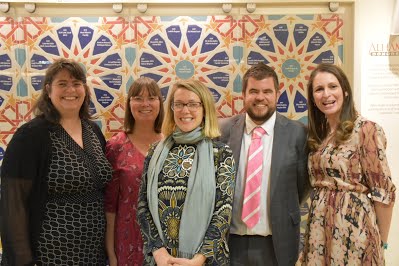
I am proud to be part of something that values subject knowledge, and is trying to improve it. The London RE Hub team 2016:
The London RE Hub website will soon be updated with all resources from the 2016 Conference. Please get in touch via TheLondonREHub@gmail.com if you would be interested in helping run the 2017 Conference.
Hattie and Yates (2012) Visible Learning and The Science of How we Learn
“Door of faith” (Acts 14:27) is the name Pope Benedict XVI gave to his apostolic letter which began the Year of Faith. This ran from 11 October 2012 until 24 November 2013 and was a key part of the 50th anniversary of the opening of the Second Ecumenical Vatican Council, yet also saw the resignation of Pope Benedict XVI and election of Pope Francis.
"Gravissimum educationis", published as part of the Second Vatican Council is worth revisiting on a regular basis by all involved in Catholic education [read it <here>], but was one of the key documents that many revisited during the Year of Faith. This extract should be a clear reminder of the purpose of Catholic schools:
Among all educational instruments the school has a special importance. It is designed not only to develop with special care the intellectual faculties but also to form the ability to judge rightly, to hand on the cultural legacy of previous generations, to foster a sense of values, to prepare for professional life. Between pupils of different talents and backgrounds it promotes friendly relations and fosters a spirit of mutual understanding; and it establishes as it were a center whose work and progress must be shared together by families, teachers, associations of various types that foster cultural, civic, and religious life, as well as by civil society and the entire human community.
Beautiful indeed and of great importance is the vocation of all those who aid parents in fulfilling their duties and who, as representatives of the human community, undertake the task of education in schools. This vocation demands special qualities of mind and heart, very careful preparation, and continuing readiness to renew and to adapt.
So 50 years on, how do we renew and adapt?
Several months ago, I spoke to Michael Merrick about the possibility of getting together some good Catholic thinkers on the future of Catholic education in this country and the vision has now become a reality.
Porta Fidei? The Role and Future of Catholic Schools Saturday, 27 June 2015 from 10:00 to 17:00 (BST) Carlisle
This is an academic conference seeking to explore the ambitions, obligations, challenges and obstacles facing faith schools in the United Kingdom. It shall consist of two keynote papers and four seminar sessions, seeking to generate honest discussion and debate in an atmosphere of collegiality and friendship.
We have a variety of speakers - from academia and school leaders, to teachers to public policy experts - presenting papers on themes as diverse as the formation of Catholic teachers, the challenge of secular liberalism to faith schooling, the 'Catholic curriculum', and the challenge of teaching RE in a post-Christian, pluralist society.
The event is organised in association with the Diocese of Lancaster Education Service.
Mary Clarkson (Labour councillor, Catholic voices, Chair of Governors)
Andy Lewis (RE teacher, Head of Year, Brentwood Diocese)
Mr Stephen Tierney (Executive Director of MAT - Christ the King, St. Cuthbert's and St. Mary's Catholic academies)
The event will commence at 10:00am, with lunch and refreshments provided throughout the day. All leftover funds from ticket prices will be donated to Mary's Meals.
One thing most teachers don't have is time. Thankfully Ross aka TeacherToolkit has collected a series of inspirational nuggets of wisdom from nearly 200 teachers in his eBook called "Thirty Words, 30 Seconds".
A quick flick through provides exactly that, Thirty Words and 30 seconds (or less) reading time for each.
There will be many, many blogs written about ResearchEd 2014. A large of number of these will give a far better and more in-depth insight into the conference than I have the time to even begin to attempt. I'm going to write about a few highlights, some RE particulars and my general thoughts coming away from a really fantastic day.
I tried to put together a Top 5 of things that I took away from the day for those who won't read any further:
Education Research tells us what has been the case, not what could be.
"It's more complicated that that."
CPD needs to be more that a one off session; a project/research model may work well.
We need a balanced diet: experience/tradition/research
"Suspend Your Disbelief": There may be a better future for OFSTED
In the Beginning...
John Bradshaw and Tom Bennett welcomed us to Raine's with the news that, despite the invite, Obama couldn't make it. My only disappointment here was no entrance music; a missed opportunity I felt. Tom said that we were looking a conference that was part of a "modest revolution... a polite rebellion". I agreed whole heartedly; we need to be cautious and curious. He made it clear we are not replacing experience, but augmenting it, "blending research and craft".
This session began with an anecdote from John Tomsett, his wife [a teacher too] asked, "Does it make me a worse teacher that I've never heard of Dylan Wiliam ?". This is perhaps a reason why only one man was genuflecting as he [Dylan Wiliam] walked through the hall during our early morning coffee:
The point being, it's hard to get research to teachers. Even with the conference, 600 in attendance and 150 on the waiting list, we are a small number! I feel that there is only a very small number of staff in my current school who are interested. How do we make research interesting, engaging, useful... and where is the time?
We were then saw a clip from one of my favourite TV series... People Like Us. I wish the whole episode was online and I dug out my DVD when I got home and watched the whole episode with my Chinese takeway:
John pointed out its a brave head who goes in the opposite direction to current trends. Although it is not an experience versus evidence 'battle'; quite simply put, if you put the two together you may get something useful!
Alex asked how we go beyond guesswork when things are constantly changing? By using evidence and research, someone needs to be the devil's advocate for the 'next big thing' (and I would add, particularly when this 'next big thing' comes neatly packaged from a company with a significant price tag). However, how do you take this from the SLT to the classroom? You need to make it easy, attractive, part of CPD and give people time!
Professor Coe rightly said, "In schools we get excited about a lot of stuff and most of it doesn't work at all." He suggested the EEF, <here>, is a good start (and will be going interactive very soon!).
John returned to explain how there needs to be changes in structure; he spoke of a 'leadership wisdom' whereby headteachers need to create culture and structures for research to have impact in schools. It simply won't happen otherwise. He finished with another clip from People Like Us and reminded us that there is still a lot of nonsense going on in schools...
John Tomsett's research project RISE is <here>
Watch the session <here>
Session 2 - Dylan Wiliam: "Why teaching will never be a research-based profession, and why that's A Good Thing"
He started out by saying he doesn't set out to wind people up; perhaps a necessary caveat given his session title, at a education research conference.
Dylan directly re-compared medicine to education (responding to Ben Goldacre at ResearchEd 2013 in some part presumably). He pointed out that 40% of GPs prescribe antibiotics for virus'; there is no effect but patients feel happy. He claims that the successful parts of medicine are compared to the failing parts of education and this is imply unfair. Dylan also said, "When teachers go to the educational research cupboard, it's usually bare."
He did not hold back in his criticism and claimed that , "Most of homework teachers set is crap". Preparation for learning is the most effective form of homework, but is trickiest to set.
Wiliam also addressed setting. He said that teachers queue their lessons with a student reference point. In top set, it is generally the most able student ("You should all be able to do this"). In other sets it is quite often a middle child and in low sets it may well be the least able ("If student X has done this, so should you"). This directly effects progress; it is not the setting itself, it is the teacher influence.
Traditionally the best teachers were given the top sets, now many schools give them the C/D borderline. Rarely are they given the bottom set. However the best teachers have the biggest impact on the bottom sets. This brought about a great sense of relief as there have been times in my career when I regularly got given the bottom sets!
Dylan also pointed out, "In education everything works somewhere, and nothing works everywhere", so we need to be very careful about holding up research that backs up or discredits certain educational ideas.
He also warned schools to be careful of the EEF; one example is that it suggests that TAs are ineffective. However, it is clear that many TAs do have a very positive impact and most teachers realise that. his was the clear message; educational research gives us what was and what has been, not what might be and could be.
He gave another cautionary tale; feedback does improve progress but it has to be right feedback. The EEF is greatBUT teachers are just told where to dig but not why; we are left as the equivalent of "intellectual navvies".
Finally Wiliam began pointing out some problems with research reports in education. Of 3000 tested, only 131 were reliable. It is important we know the science (and neuroscience got a good few mentions during the day), but we must temper with judgment. The purpose of educational research should be to move teachers towards more effective action. Too often the findings of research are what good teachers do already do and others can't or don't (or won't take the time?) to understand. Wiliam said when he first instructed trainees her just said "just do what I do, it works for me."
His final closing comment was that "all teachers should be seeking to improve - that is our moral imperative".
He spoke a lot of sense and it was hard to disagree with his notes of caution.
Session 3 - Andrew Sabisky: Nature and Nurture - the Genetics of Education
Opting to save Andrew Old vs OFSTED for home release (I wanted popcorn for the spectacle) I found my fellow RE teachers, Daniel Hugill and Neil McKain for a bit of psychological research.
Sadly Andrew's PPT wasn't working, which left us doing some mental maths... it was still too early!
However there was some clear messages here: 40-70% of the differences between individuals for some traits (e.g. behaviour, nicotine dependence) can be attributed to genetics.
Many classroom and learning behaviour may be down to genetics but overall behaviour can vastly improve with intervention. A very disruptive 'unteachable' student can become a charming pain in the butt!
This does not make us redundant as teachers, but is an important consideration. We may not be able to 'close the gap', but it may be more of a 'moving the bell curve' which is still raising standards and improving the education for all. Crucially chasing equality of outcome too far is a big mistake.
Andrew left us with the scary fact that cognitive decline begins at 25! But reminded us of his belief that that success "is not in our stars but in our selves".
Session 4 - Martin Robinson: The teacher and the researcher: the time has come to talk of many things...
Martin began with a poem, performed with gusto, which entertained us all. It's worth watching via the link at the bottom of this section).
He began by pointing out that the strength of anything reduces over time: even mice in the lab react differently over time. However schools must ask, "do you want unquestioning teachers or rational thinkers? Would you silence someone who had chance to present research that undermines your institution?” Sadly, as Martin said, headteachers can be the 'ubermensch' attempting to guard against collapse of the system in light of inconvenient truth.
Martin then went to to make some science and health analogies; tummies rumbled at the talk of food and the smell of the near-ready 'Lunch of Champions'. Science has changed over the years... now you can eat butter, he exclaimed!
Firstly were told you needed 5 veg a day, but potatoes don't count (this was only because they were worried peoeple would count chips). Then 5 veg a day, but potatoes DO count. Others say 5 veg plus 2 fruit. Some say there is no difference.
Things change. Does anyone really know what a good diet is? We are just trying to get closer to it; we may need to contradict previous ideas.
As it is impossible to follow 'correct instructions', we must undertake a balance diet. This involves common sense, a bit of everything, a bit of exercise, a bit of educational research, some experience... "don't chase just one flavour!"
He went on to talk about many areas of education that won't be researched. Contact time, pay, & authoritarian school leaders... all things that may well be vital to the success of our schools.
Martin also pointed out that our "best teaching might occur when you're not trying" and that actually a plane without a pilot might actaully be safer.
We were then given a quote from Charles Darwin:
"...if I had to live my life again, I would have made a rule to read some poetry and listen to some music at least once every week; for perhaps the parts of my brain now atrophied would thus have been kept active through use. The loss of these tastes is a loss of happiness, and may possibly be injurious to the intellect, and more probably to the moral character, by enfeebling the emotional part of our nature."
Our schools are not based on pure reason, they are not clinical. They are "not rational places and if you question things too much you may damage its ability to do what it does". Often they are based on traditions and you may well destroy the things that hold it together if you try to get rid of this irrationality. However reason must also be part of the conversation, "It helps with the journey towards truth, but it is not truth itself."
He reached a conclusion asking the question for headteachers, "If you allow teachers to think things through, how far will you let this go?"
RE Networking took place in the Science Garden where we met The Golden Calf. He tweets and blogs a lot of sense about the state of RE today. We investigated the CU posters (apparently very popular and student lead) and admired the views over London town.
Session 5 - Tristram Hunt MP
This was pretty dull, MP speak. Nothing really new, nothing exciting. A well executed script with a few shakily answered questions; I'd worry having him in charge of schools. He raised a laugh by calling ResearchEd "The Woodstock of Research in Education", but that was pretty much the highlight.
He did say that improving teachers was key, still hinted at the license, but played the crowd by saying wanted to give teachers the time & wherewithal to become “practice-informed & research-inspired”.
"I think education is necessarily emotional... We all have a personal stake", Mike began. He made it clear something that is so often evident on Twitter and in the blogsphere: "We don't all agree... It is not self-evident what good is... and it has changed."
He said that RI has improved the system and helped get better deal for students especailly those schools working with HMI.
Mike then started referring to AN Whitehead, "A merely well-informed man is the most useless bore on God's earth. What we should aim at producing is men who possess both culture and expert knowledge ..."
He then stated that any inspectorate should be relentless in pursuit of success and that it's just as important to consider the how as well as the what. We do need to consider what kind of relationship the inspectorate needs to have with schools. It should not be as the 'DeathStar' or as "a toxic toad say on the head of school leaders" (real description of OFSTED given to MC)
Should inspection be war? Could it be more of a dance?
Then the promises began... a new slim, single framework. There will be more HMI and school leaders will be involved. All will be directly employed by OFSTED. There will be a regional structure that offers greater support, especially to struggling schools. Potentially there will be much less focus on grades (1-4) but just 'good enough' and 'not good enough' (I can't see exactly how this works personally!).
He asked whether or not good schools need full inspection. A short, robust, professional dialgue should be suffiecnt with a letter published rather than a report. It will be about redefining relationships. Currently 6/10 schools are Good and 2/10 are Outstanding (and the plan is to still leave them alone). However, it was made clear that inspections or visits can't take place with out visiting classrooms, but not with a clipboard. There is an open consultation taking place and as many people as possible are encouraged to join in; it's hoped at least 23,000 will.
He then began to point out the realities. There will be change from this September and more from next September, and it will continue to evolve. There will be a large consultant: what should we inspect? How? When? WHY?
However individual lessons WILL NOT be graded and heads CANNOT use OFSTED as justification for doing it themselves. He would say to the head "why are you doing it?" It's up to them but they CANNOT say it is for OFSTED.
For RE teachers, it was pleasing to hear that OFSTED realise that they don't inspect SMSC well enough (NOT RE but often closely linked and often the responsibility of the RE department). There is more <here> from Dawn Cox.
The final message was "suspend your disbelief"; OFSTED may well be getting better. Mike Claddingbowl seemed like a good guy, who does want to listen to teachers and does want to make things better. Only time will tell if he can...
Our brains protect us from being wrong - it's not a logical or rational organ. We have confirmation bias and a backfire effect: we don't like being wrong! We also suffer from illusion of asymmetric insight: we even think we know other people better than they know themselves.
There is Sunk Cost Fallacy: we sit through film even if it's crap but we've paid for it. We can't get money back but can get the time... but we can't back out as we'd look like idiots!
We are susceptible to the anchoring effect: if someone tells us a student is a c we believe them
David pointed out that even if we recognise these things, we often don't see our own bias. We prefer a reassuring lie to an inconvenient truth. When others disagree with us, we assume they are ignorant, stupid or evil!
This is the essential problem with educational research. It is not the same as proof; it can be used to prove anything. Context is KING, can we generalise? What do we do if it conflicts with our values? What is the unit of education? Time/progress/amount of knowledge?
SO, what should we do?
What research says?
We've always done?
Works for us?
What gets results?
What OFSTED wants?
Can we make predictions that are meaningful and measurable?
Does a physicist examine all atoms to give predictions about atoms?
Do we believe children are broadly similar or different?
Can we make generalisations about how we learn?
The Burden of Proof means we need to ask how likely is it a duck? Do we need to prove that it is a duck? Or that it's not a duck? Learning styles confirm what we think, "It's a duck!"
Always, always, remember the bias blind spot! (Just like cars with motorbikes)
Some of the things that are probable:
The spacing effect - we forget what we learn, ensure regular review of content
The testing effect - study test test test - test is best way. If we study study study study - test, it creates an illusion of knowing it.
Cognitive load theory - the working memory is finite; greater long term memory assists learning
David left us with the words of Carl Sagan, "a judicious mix is what we need". Ultimately we have to make guesses....
Academies Weekly Special Edition is <here> Tom's reflection is <here>
Afters
We then all piled over to the pub and continued the ed chat, meeting lots of people I follow on Twitter. Lot's of respected educational peeps were all hanging together in the pub... interestingly there didn't seem too many arguments!
This summer has been dedicated to an amazing delayed honeymoon in Dubai, on safari in Tanzania and then a week on the beach in Zanzibar... it was GREAT!
However now it's back to business and a number of education bloggers have been helping with the new years' preparation. I agree with Tom Sherrington when he said, "Over the last two years, I’ve found that I can engage much better with the ideas in some of these books when I’ve seen the authors express their ideas directly – either in person at a conference or through some of the video material on the internet." (<here>). It's also why I love TeachMeets, teachers expressing ideas from the books in a real and practical way!
Tom's post, "Contemporary educational ideas all my staff should know about"<here>, is a great starting point for beginning conversations about the most up to date ideas. This is vitally important, as every now and again I hear staff talking about learning styles and even brain gym!
Shaun Allison has also put together an excellent collection of videos <here>. In time where staff can really take control of their CPD, this is an easy and accessible way into many contemporary ideas. They are ideal as a starting point for discussion in a school or department session, or simply as a bit of personal viewing!
The Educators on BBC Radio 4, <here>, has also brought some up to date educational ideas to the general public; teachers were listening and ready to blog, particularly when John Hattie made an appearance. Two great overviews of this are found <here> (concise from John Smith) and <here> (a little longer from David Didau).
That's me started off... (tickets are also booked for ResearchED 2014: see <here>)
I wonder how I can bring a few more colleagues along with me this year? I got 9 staff to TeachMeet Havering (in our school!) at the end of term and I'm ready and refreshed to start these conversations again.
This was the CPD course that I won at #TMLondonBus and was of great excitement for me as its the kind of course I would never normally get the opportunity to attend. Due to 'rarely cover', the majority of CPD courses at my school can only be exam board courses. However as this prize was non-transferable, I got to go!
Collaborative or cooperative learning features in both Hattie and the EEF's research. I've always found this has mixed results, and keeping all students working and on task can be hard... there are often dominant individuals and those that see it as a way of escaping doing work!
We looked at some strategies that I have already tried (and re-tried since) in my class. Allocating different tasks, separating information and so on can all work, but need careful planning. For me, it has to have a better outcome than working individually, or be looking at developing specific skills. Too often it doesn't.
My Y7 class have recently been working in groups on a wiki (see <here>) and so were all 'experts' in one religion. They then wrote 5 questions and answers based on their area of expertise, which they all had to memorise. Students then went around the classroom with a 25 question and answer sheet and needed to get it filled in. This resulted in them working collaboratively to gain some information about the religions that they hadn't studied. It was just simple, factual knowledge, however for those sharing their area of expertise it reinforced their own learning and helped them grow in confidence to talk about what they had been learning.
4) Peer Tutoring
Again something I've had mixed results with in the past. We used different sections of the room, breaking down questions, teaching one another and moving around the room. For me, the clear thing here was actually the ability of the teacher to break down the questions clearly and in a graduated way.
I often use 'experts' in my classrooms (particularly with Y7), which is something I got criticised for from OFSTED (see <here>). It has made me realise that I need to perhaps think a little more carefully and critically about how I use them to have greater impact. I also should try it with older students, they just tend to be a little more self conscious about being the expert! However if everyone has specific, allocated roles, it may work better. Careful planning again the key here.
5) Digital Technology
This could literally mean anything. When highlighted by the EEF, it is referring to tablets (iPads etc) apparently. Hattie doesn't make any note of this.
The key thing here, which is nothing new to me, is that if it simply used as a ‘glorified toy’or a substitute for laptop, it has no impact. However when focus is on pedagogy they do have an impact… if a tablet is creating challenge, engagement, enabling and demonstrating progress, or giving feedback (the big four considerations). It requires careful thinking about the Apps or websites used.
There was a discussion about funding and finance and that actually many schools could (and do) implement BYOD [Bring Your Own Device]. I have done this on numerous occasions, asking students to use Socractive, making videos or just simple research; they basically have a computer in their pockets!
The two apps that were looked at were Aurasma (augmented reality - digital content linked to physical content) and Educreations (Take photo, record video, mark, upload). Augmented reality is very cool and fun, it grabs attention. However I'm still not overly convinced on it's ability to enhance education. Yes it creates engagement, but equally I'm not sure I want students walking around school using their mobile phones on display boards. Educreation as a tool for marking is again engaging, but ultimately hugely time consuming when I have a heavy workload in this area already.
There is a big place for embracing technology in education, but as an RE teacher, I'm not quite sure how it is best used yet. This said, I do get my students, blogging, creating wikis, engaging via Twitter... None of this has cost me, or the school, a penny to date. The cost versus impact is a debate that will continue to run.
6) Metacognition
This is 2nd on Sutton Trust, 'knowing about knowing', and often cited in current education research talk.
We focused on Mind Maps and looked about 'how we learnt' the story of Leonardo Da Vinci, and detailed our method:
Phase 1 - Listen to short story and create a mind map with pictures only [numbers allowed] (code)
Phase 2 - Retell partner story (decode)
Phase 3 - Add some key phrases
Phrase 4 - Listen and correct (check)
Phase 5 - Organise -> Look at each paragraph and look at topics: skills, early life etc
My students are not fans of Mind Maps. There is a tendency for some girls to get overly obsessed with neatness and as a result, don't like to make them as they get messy! However we then looked at different types of diagrams and I must admit, I gravitate towards one or two styles when it may be better to use alternative models when presenting ideas:
Meta-cognition and associated ideas such as 'Learning To Learn', study skills and so on are very important but rarely do they get taught well. It again gives me something to think carefully about in my provision of Citizenship/PHSE programme next year as Head of Year 10.
Self-evaluation and self-regulation are important, but how do we teach this to our students and is it best done discreetly as part of good teaching, or in separate lessons? This section was more a start point to reflection rather than a simple answer.
7) Feedback
We began by doing the 'house drawing task', where criteria was given afterwards. This is always a powerful exercise and reminder of why we need to make criteria explicit and why it helps with feedback!
There are four types of marking:
Specific
Non Specific
Positive
Non Positve
This leads us to Feedback (specific positive) and ‘Feedforward’ (specific negative). However I admit that I also use non-specific positive when marking KS3 and KS4 to motivate and encourage. It is not possible to mark everything in detail... but I do believe that comments and stamps which give a simple reinforcement of hard work and effort so still have a place.
However everything needs criteria in order to give specific feedback... are they explicit or implicit? Does the teacher know what it is? Does student know what it is?
All types of feedback has positive and negative:
Teacher written feedback
It's personal, formative and expert BUT is it just one improvement? It's time consuming! Do they respond to it? Does it have impact?
Teacher feedback with technology (also includes stickers, comment banks)
It's formative, expert and time saving BUT does it have impact? Is there a perception that its not personalised?
Teacher with coding (includes colours/letter/numbers)
It's formative, expert and time saving BUT does it have impact? Is there a perception that its not personalised?
Teacher marks one and gives whole class feedback using technology
It's formative, expert guidance, time saving and reusable BUT do you access to the technology? How about children (and parents) that object to their work being 'picked on'? Engagement?
Dialogue takes place and has impact, it's formative, expert and time saving BUT there is a perception that the teacher is not doing their job? There may still be errors? Is it suitable for all ages and abilities? Is it time consuming to do for the class?
Peer marking (against the criteria)
It's formative, expert and time saving BUT what are perceptions of the students and parents? What about errors? Is it suitable for all ages and abilities?
Dylan Williams was cited at this point, in saying that 'all marking is a waste of time if no impact, dialogue, response or conversation' (could be a paraphrase here!). This could be as simple as getting students to write exactly what they are going to do to improve on feedback, and time needs to be given to do that (currently known as DIRT time - Directed Improvement and Reflection Time).
There was also the possibly of bringing research into the classroom... Can we do a RCT (randomised controlled trial)? Two similar classes within the school, with all other factors limited, one with an active intervention... what would the results be>
To conclude our session on Feedback we watched this:
Feedback and marking were highlighted as a school in both our Section 5 and Section 48 inspections. As a department, we spend a lot of time marking, but is something we are in the process of reviewing. How can we ensure greater progress? How can we help our students to improve further? How can we better use our time? Again, this didn't give all the answers, but certainly a start point for further thinking.
Overall
I thoroughly enjoyed the Research for Learning (RfL) course and would highly recommend it. Rarely do courses provide hands on Teaching and Learning days that are cross-phase and cross-curricular. Rarely do you walk back into school having had time out to reflect, and come back with new ideas and enthusiasm. People sometimes criticise the EEF and Hattie, but at this point in time, what else do we have as teachers? It's certainly a start point. No-one does know your students like you do, but can we really ask people to take the teaching profession seriously if we are the modern day equivalent of Quacks? RfL is Drangonfly's brand of the DfE's Evidence Based Teaching (EBT)... my question, do we need to brand it as new form of pedagogy or is it simply the only way forward to ensure a robust professionalism that is informed and based on sound research?
This was the CPD course that I won at #TMLondonBus and was of great excitement for me as its the kind of course I would never normally get the opportunity to attend. Due to 'rarely cover', the majority of CPD courses at my school can only be exam board courses. However as this prize was non-transferable, I got to go!
This course was a teaching and learning day that focused on what was labelled 'The Magnificent 7'. These are the seven most powerful ‘impactful’ interventions to improve learning based on Hattie and the EEF Toolkit combined.
The background to this is that there has been a shift from the 1970's uninformed free practice, to a National Curriculum in 1998 that introduced uninformed prescription, before in 1997 there began informed prescription. Potentially (and hopefully!) there will now be a move to a future of informed professionalsim.
The terminology was not lost on me, as a big Western fan. The film's tagline, "They fought like seven hundred" indicating their effectiveness and impact. The Magnificent 7 here were:
1) Piagetian Programs
2) Direct Instruction
3) Collaborative Learning
4) Peer Tutoring
5) Digital Technology
6) Metacognition
7) Feedback
1) Piagetian Programs
Hattie put this at 2/138 so it is worth investigating! SOLO taxonomy was touted as being a bridge between Piaget and practice/pedagogy. It gives a clear hierarchy of learning, including differentiation and can help inform lesson objectives.
For the majority of lessons, it was suggested you need one multi-structural and one relational verb in the objective. Additionally this will help differentiate lesson objectives:
Multi-Structural - All
Relational - Most
Extended Extract - Some
These SOLO terms are from a taxonomy that is lesser used than Bloom's, but as many are now suggesting that as they are linked to Piaget, it is quite possible better. The teacher sees what level they are at, and then actively pushes it on. Students recognise the associated shape and realise they need to move forward:
To try the relational stage we used hexagons in a short exercise. This is the point from where students make progress in bringing together ideas... where they explain and analyse. Justifying the positioning of the hexagons allows this thinking to take place.
This has encouraged me to think about using SOLO in my lessons. I know Sam Betts has been using in A-Level RE and I will revisit some of his resources. We worked together on a grid (see <here>) for students to map their progress and he added SOLO logos. I took them off as I hadn't used this approach before but now think I may readd! A friend of mine, Andy Knill, is passionate about SOLO and runs the GlobalSOLO network which may also be of use.
I think it may also work very well as a consolidation, revision technique. It's important the students know the facts, but often it is then joining them up (relational) and hypothesize (extended abstract). I also don't think this is necessarily changing my teaching, but thinking with greater clarity about where I am headed and how I can help my students realise that too. For any topic, ideally they would get to the 'extended abstract' stage... and if they simply stayed at the prestructual we'd all be in trouble!
2) Direct Instruction
This was called 'the meat and potatoes', or the basis of most of our lessons! The 7 steps to this are as follows:
Step 1 - Decide Topic & Objective
Step 2 - Provide Input (Video/Text)
Step 3 - Give 3 bullet points of what happened on mini-white boards -
pupils reflect/respond to the objective on the white board - the teacher
gets feedback from this
Step 4 - Decision (based on the feedback) - 3 options ->
push on, identify some that need extra support or reteach
Step 5 - Decide a task to meet that objective directly - e.g. write a paragraph with success criteria (see below)
This was a really handy reminder of the basics and what they need to be. It's also 4/138 from Hattie, and if done well can produce regular, good solid lessons. It is important to factor in Step 4 (the most important step I think) and be flexible within lessons. I know I am going to ensure more success criteria are given even for shorter class-based activities and not just assessments.
There are two events coming up in September that I want to attend. The first is ResearchEd and the second SLT Camp. Last year my school paid for ResearchEd and for my travel to the Culham St Gabriel's Weekend; both were are at weekends.
I am about to submit applications to my school for both. I am very much hoping that my school will pay for both, but last night I considered what will happen if they say 'no'; will I pay £140 out of my own pocket, plus travel?
I am interested in EBT and Educational Research, but often feel quite on my own at school. I have attended meetings at the DfE and like reading and trying things out in my classroom. I've tried to sell it to others, but with little success... so far! I won a DragonFly course on Research for Learning (RfL) at TMLondonBus which I will be attending in June; my school have given me the day off thankfully. I don't have much in my Performance Management linked to EBT, nor is it part of my TLR, or obviously exam board related. However, I found ResearchEd inspiring, interesting and gave me ideas for my own teaching in many small and often unrecorded ways.
SLT Camp will be interesting. I am not currently SLT, and can only be considered 'aspiring SLT' (in a few years). I am assistant subject leader in RE, which may or may not even be considered a Middle Leader. I work in a Catholic school which means it is a far greater responsibility than in other schools. I have also lead a number of whole school initiatives such as our Family Learning Project, Open Door Week, Marking Swap Shop. I want to start developing the skills I need, and learning from other SLT members... I also feel I have something to offer!
Ultimately if my school say they won't fund them, I will reluctantly fund myself. I believe that my CPD is now something I can take hold of and control. I largely have Twitter to thank for this; blogs, TeachMeets, online coaching, EduBlog curries and so on have all played a massive part. Thank you to all who have helped, and continue you help me; I'll be seeing you in the Autumn term.