I only realised in retrospect that I got my first nugget in meta-cognition from Frank Skinner. A few years ago he spoke about getting old and one of the ways he keeps his brain as active as possible is by imposing a rule of only Googling things he doesn't know, and not what he doesn't remember. This is essentially the practice of memory retrieval, a vital skill for our students. I spoke about this at TM Newham hosted by Jonny Walker at Elmhurst Primary on Thursday 3rd November 2016.
At the second annual TeachMeet held at Compass School Southwalk in Bermondsey, I decided to take up the theme from a recent blog post (see <here>) and speak about using the word 'love' in schools, inspired by St Augustine.
Should it come as a surprise that teachers love to learn?
“Every teacher needs to improve, not because they are not good enough, but because they can be even better.” - Dylan William
It's clear by the way teachers sign themselves up for evening TeachMeets, weekend debates, Pedagoo events, ResearchEd, T&L Takeovers and Education Festivals that many of us care deeply about our jobs and are always keen to improve. I ran a Twitter poll that 120 teachers responded to: 43% had given up 1-3 Saturdays for CPD, 13% had given up 4-6 and 5% over 7. It does weigh heavily upon me that I have organised, and presented at events on so many Saturdays this year - should teachers really be doing this after a long working week? Shouldn't they be with their family and friends?
Many of the above events focus on pedagogy or general teaching related ideas. When we began planning our first RE Hub conference in 2014, we wanted to do something different. We wanted to focus on subject knowledge and how to get it into the classroom. Saturday 16th April saw the second annual London RE Hub conference, an event that I am still recovering from and trying to contextualise.
RE teachers can be a strange breed, particularly as there are some real fundamental things we don't all agree on (approaches, the name of the subject, the place of spirituality, the definition of theology...). Our subject covers a board range of topics, and has been colonised by British Values, the Community Cohesion agenda, PHSE and SMSC. There is also the divide between schools with a religious character and community schools, now made more diverse by the academisation process.
I think that I first fully realised how much we as a community loved learning when I attended the 2nd Teach First conference and managed to sneak into John Moffat SJ's session on Grace. Here was a Catholic priest, giving an in-depth lecture on a difficult Christian theological concept. The room was in awe. How much of what John said could I take back to the classroom? I'm not sure; I even work in a Catholic school!
Reading the feedback from the London RE Hub conference, people loved the day as they got to learn. They heard experts explain their beliefs, answer questions on the core concepts of their faith, and ask some difficult questions. We went beyond GCSE level, sometimes beyond A-Level - while primary and secondary colleagues share the room. We tried to build in parts of the sessions where teachers tried to explain how to take these ideas back to the classroom, but in many cases the teachers simply wanted more input, more knowledge, more insight.
Hattie (2012) suggested that teacher knowledge did need to be secure, but that it shouldn't create an empathy gap between student and teacher. Yet we know it is something that students value... many students have said they believe I must be a good teacher as I have a Religious Studies degree from Cambridge; it makes them feel secure. Students want to know if their teacher is, quite simply, good enough.
The Sutton Trust (2014) made clear (and is highlighted in an excellent RISE blog <here>):
“The most effective teachers have deep knowledge of the subjects they teach, and when teachers’ knowledge falls below a certain level it is a significant impediment to student;’ learning. As well as a strong understanding of the material being taught, teacher must also understand the ways students think about the content, be able to evaluate the thinking behind students’ own methods, and identify common misconception.”
RE teachers often recognise that they have these gaps, and want to fill them. In a subject where we are often struggling for subject specialists, and often see the subject being taught by non-specialists, even at examination level, this is a great concern for the RE community.
Fighting for subject knowledge CPD is tough, and it will continue to get tougher. Schools are struggling with budgets, and as someone told me on Twitter, such study days are "self indulgent". I politely, and respectfully disagree. The fruits of the conference continue to grow, those who studied together on that today build networks of support and exchange. Despite my worries about 'stealing teachers Saturdays', I know I am willing to do it myself (and make up the time to my wife and young son!), and will continue to do so. The most humbling thing for me, was that teachers travelled from all over the UK to attend our day; thank you from the bottom of my heart.
Some further questions:
How can we create opportunities for staff to develope their subject knowledge? (I love the idea of one INSET day being given over to subject study - for RE teachers, visiting places of worship etc)
How can we encourage a community of learning in schools alongside the current demands and stresses?
How can staff best share their learning with students if it doesn't quite fit the curriculum?
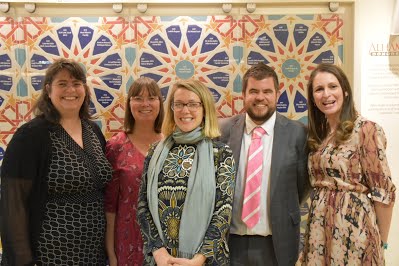
I am proud to be part of something that values subject knowledge, and is trying to improve it. The London RE Hub team 2016:
The London RE Hub website will soon be updated with all resources from the 2016 Conference. Please get in touch via TheLondonREHub@gmail.com if you would be interested in helping run the 2017 Conference.
Hattie and Yates (2012) Visible Learning and The Science of How we Learn
It is a great privilege for me to be involved in #TMLondon. For the second time, I have been working behind the scenes organising sponsorship, goodies and prizes for the evening. On the day, I was largely running around setting up and checking the competitions and managing the Twitter account. The only downside is that I don't get to hear all the speakers, nor say hello to everyone!
However, to be part of such an exciting and dynamic event that provides really genuine and authentic CPD for those who attended is a really great thing. I'd like to thank Ross for the opportunity. Here are a few ways to find out what happened:
Jonathan Peel was our winner of the M&S hamper courtesy of edukit. Read his blog <here>
There were lots of great blogs on Staffrm, read them all <here> - The Staffrm team picked their best blog which belonged to Jaz Ampaw-Farr, read it <here>
EduKit is a social enterprise part funded by the DfE putting people before profit, we want to help all schools find the relevant support for their students, we have built a FREE online platform that can connect schools to external organisations that offer student programmes to help with all types of issues your students may face. We have over 800 organisations registered and more joining everyday! 30% of our programmes are FREE. It is completely FREE to register and use and all staff are welcome! Feel free to sign up and have a look https://www.edukit.org.uk/register/
ClassCharts have offered to pay for dinner for two! This will be at a restaurant of your choice. In order to win this, you need to write a blog about #TMLondon - What Happened Next? You could blog about an idea that you used in your classroom, or an idea you share with collegaues. Have you been inspired to run your own TeachMeet, or have you made a new network connection. The deadline for this is Thursday 21st April 2016. The #TMLondon team will pick a winner. Please email all entries to TeachMeetLondon@gmail.com
Seating plans in seconds & super fast behaviour management
We enable teachers to use the moving image and sound to facilitate teaching and learning. Our online service, Box of Broadcasts provides access to over 2 million broadcast TV and radio programmes and we would like to offer free trials for a month to every school attending Teachmeet London next week. To request a trial, teachers just need to email their name, school name, a start date for the trial and a contact email address to: BoB@bufvc.ac.uk. The subject header in the email should read, "Free trial of BoB." There is no obligation to subscribe. In case teachers wish to know the annual rates should they decide to subscribe, they are: £600 + VAT (Special and Primary Schools) £1200 + VAT (Secondary Schools)
As well as arranging the competitions, prizes and thanking our sponsors I managed a 2 min presentation at TM London:
A short reflection as a current Head of Year, former Form Tutor (something I really miss) and member of Athens 1995 to 2000.
I remember how he was there on there on day one to make us smile and feel relaxed. He told us all the vital information that noone else did. The toilets are there… Lunch is at 12.30pm… Make sure you get a parent to sign your planner for Thursday.
I never felt like we were an afterthought or an inconvenience in his busy day. In fact, he got to the form room 5 minutes early at PM registration if we wanted a chat. I knew he would be able to help any issue that I had. Academic, social or even personal. He was someone who I could really trust.
He checked our uniform twice a day. In the end, we just knew to be smart. At the end of registration we always stood behind our chairs, went silent and he wished us a good morning or good afternoon.
If our form tutor wasn’t there, we always knew what to do. Wednesday was always silent reading day. Cover teachers were always amazed that we got our books out and started reading automatically. Our tutor used to read his book during this time too.
He checked if we had a pen in the morning. If we didn’t, he’d lend us one. We had to spend 15 minutes doing ‘community service’ at lunch to make amends though.
On a Friday, we had a form assembly. He used to insist that we included 3 bits of news: local, national and international. Someone then played their favourite song on his cassette deck, we all listened, even if we didn’t really like the music choice.
We used to get ALL the school news. Other forms came to find out from us. Everything was read out and went on the notice board. We all got involved in lots of extra curricular activities.
Our tutor had his purple folder, he called it the Bible (he wasn’t religious, but said it was the most important book he had). He kept track of everything to do with us in it: letters, detentions, merits...
Lots of other forms didn’t enjoy PHSE lessons, we did. It was clear our tutor knew what he was talking about it; it was like any other lesson. Sometimes better.
We didn’t want to get in trouble, it was like letting the form down. Our tutor wouldn’t shout if we did, but he always suggested we apologised to the teacher we had upset and make amends.
He wasn’t our friend, but he was special to us. We belonged to him, and him to us. We used to laugh when he told us jokes, and we all got very sad when his mum died.
Fast Forward 20 years…
My great form tutor is the front line, she picks up on everything. She is my ears, eyes and heart in 11X. She is the adult the students see twice a day, she always notices first if something is not right.
She knows which students are doing well, and in what subjects, she also knows where there is a cause for concern, and she always lets me know. She has great relationships with the students, and many of the parents.
It may be chance that absence is less of an issue in her form, but she follows up notes straight away and always finds out why they weren’t in school. Her form are always the most involved in every inter-house competition and charity event, even in Year 11.
She has helped every student plan their revision, and discusses stress relieving techniques with them on a regular basis. She also always has an activity up her sleeve: a quiz, a puzzle and thinking game.
Her form never leave registration noisily, they are always ready to work in Period 1 and 5.
She has really high expectations, of everyone, all the time! One student said, “She’s like our school mum”. Being a form tutor is one of the most human parts of being a teacher.
Great form tutors make it easier for everyone to teach, and everyone to learn.
Form groups are often when the happiest memories are formed, and everyone remembers a great form tutor.
What kind of form tutor are you?
This isn't a true story sadly. It's a mixture of what I experienced at school, what I wanted at school, what I've tried to do, and what I encourage others to try and do.
Sadly I was unable to attend this TeachMeet and support the amazing team behind it - they were so supportive of TM Havering events and I wanted to return the favour. Their theme was "#FiveIn5" which a brilliant way of focussing loads of advice in a small slot (and similar to the Starter for Five blog). Anyway, here is my video presentation of on "Being A Great Form Tutor:
At TM CSS, a leadership-focused TeachMeet, I shared a 7 minute presentation reflecting on pastoral leadership. This is so often not a feature at TeachMeets, nor on blogs or Twitter. This may be partly due to the sensitive nature of many aspects of the job, or perhaps due to the difficulty in suggesting transferable ideas from one school to the next. The questions I want people to go away thinking about are about their pastoral responsibilities... as a classroom teacher or as a senior leader. Also about the time, space, status and reward they give to pastoral leaders in their school: are you doing enough?
At TM Islington, I shared a 7 minute presentation on embedding some metacognition into my lessons including some 'quick wins' to incorporate into lessons planning. Ultimately we spend a lot of time preparing excellent lessons, but then don't always ensure that students remember them. What can we do to try to improve this?
I was very honored to key note the inaugural meeting of the Herts Secondary NATRE Local Group. It was organised off the back of The London RE Hub (see more <here>) by Laura Passmore, Becky Shah, Laura Pope and Flora Richards.
It was a fantastic evening, putting a lot of names to faces and sharing some great RE discussion. A note of real thanks must go to Flora's school and students who were amazing hosts. The students were incredibly polite and helpful; they were interested in the event and desperate to look after our every need. Particular note must go to the 'welcoming committee' who were shaking peoples' hands and ensuring I had a chair to "rest my weary legs". The surrounds at Aldenham School were stunning, with hospitality as warm as the weather!
Inspired by Neil McKain, I decided to try and use Periscope for the first time. As Neil has said, he wants more RE documented so it can be shared more widely via Twitter, Save RE, other Local Group meetings etc. This is why were very keen to get all of The London RE Hub filmed too.
First up, I delivered a key note on The Future of RE, similar, but more consise than my presentation to Teach First on Saturday (see here):
Apologies - I can't remember who took this and tweeted it to me!
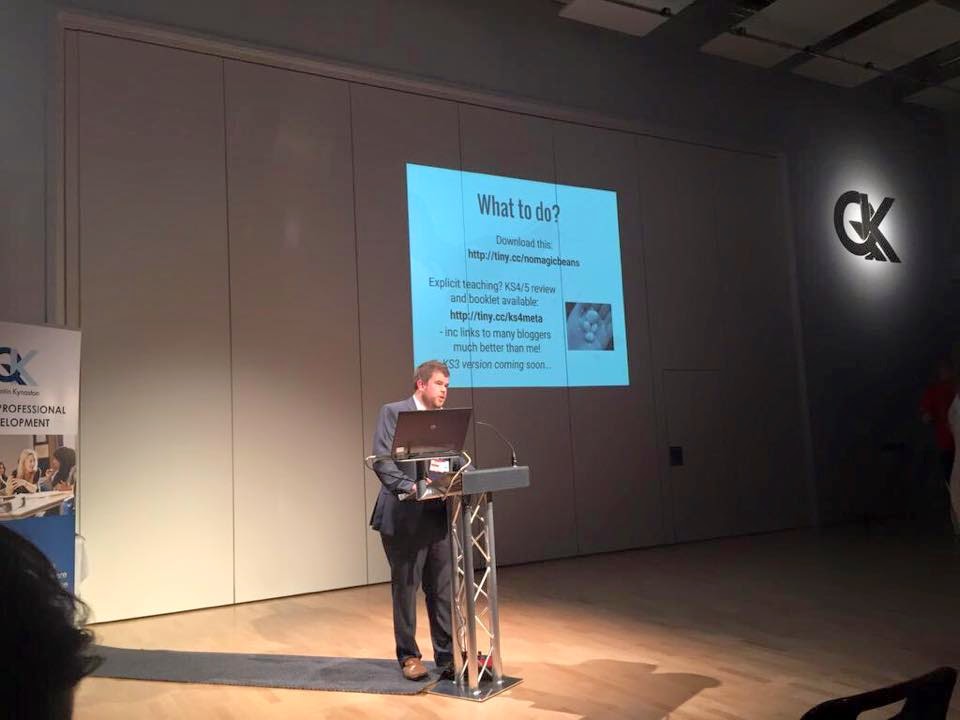
Thank you to everyone who said kind things about my presentation both via Twitter or in person at #TMLondon. It was a great evening and a real privilege to present and share something with the huge number of colleagues in person and online. Here I will outline what I covered:
I have written a blog post about what I am doing with KS4 classes which is <here>. I have done with my Y10 year group (I am Head of Y10) and my two Y11 RE classes... "Why has no-one ever told us this before?" some gasped. I am also looking to do a KS3 version ready for their end of year tests. I hope to sow some seeds of though; they're not magic beans though!
I also hinted at the fact that meta-cognition / cognitive psychology is NOT a magic beans solution. This is something that Carl Hendrick has recently blogged about <here>. As he says, "to my mind there are four areas in education research: philosophy, anthropology, sociology and of course psychology and at the moment I worry that we seem to have hedged all our bets on the latter."
Somehow I also managed to get a reference in from Frank Skinner, my favourite comedian. A few years ago, he discussed how he tries to ensure that his memory doesn't deteriorate with old age by only Googling things he doesn't know, rather than things he doesn't remember. I think this is particularly important when we have the internet often just a button away....
A few people have said they were surprised by the information on my "Hot or Not" slide. This comes from an article from a number of top cognitive psychologists which can be read <here>. A summary is also available in my student booklet <here>.
Finally, if you fancy watching it again (or indeed for the first time). Check out the video below... fast forward to 37mins:
Firstly, I would like to say a huge thank you to everyone single person who came to TMLondon (again!). There were around 250 in attendance and around 200 were watching online. 450 teachers, in their free time, wanting to learn about being better teachers. That is incredibly powerful and very much 'good news' for the profession. I am disappointed that Nicky Morgan, Tristram Hunt and David Laws didn't accept our invites and come along.
A big thank you goes to every presenter. Due to my "prize man" role on the night, I have not yet caught up on the whole evening yet. Thankfully Leon Cych captured the whole evening and I can watch again in my own time, probably bit by bit! If the tweets and blogs are anything to go by, there is so so much to take from the evening.
I'd also like to say a big thanks to team #TMLondon - Ross, Mark, Di, Amjad and Martin. All people absolutely dedicated to making education better, all in very different ways. Particularly thanks must go to Ross, Alex, Asmy and all the staff and students at QKynaston - a fantastic venue, hosts and the perfect bit of positive PR they needed. Thank you.
This is me taking a selfie in Ross' seat in his office
Our sponsors also need a massive thank you. My table was FULL of prizes to reward those who had given up their free time. There is a list up <here>. There are still some prizes to win... find out how <here>. It meant we had lots of food and drink, lots of goodies to take home plus many went home very happy with some excellent prizes including vouchers, IPEVO cameras, dinner in the Shard, ipods, books, subscriptions and much more! Thank you SO much to all. TMs shouldn't be dependent on sponsors but it is a nice reward for those who give up their own time to come along.
Please email any further blogs to TeachMeetLondon@gmail.com - if you would like to be considered for a specific prize mention that too! Full details <here>
Thank you all so much for coming! As one of the organisers, I was genuinely humbled by the kind words from those at the event and online; it was very much appreciated. However, it does end yet...
We still have THREE prizes to award:
1 x Twinkl subscription
1x Optimus Education conference place and training pack
1x Insights Discovery Profile from Brightfield Consulting
To be in with a change of winning these, you must write a blog about TMLondon. It could be about one particular presentation (but not your own!), or about the whole evening. Those who viewed at home can also take part. Prizes are subject to availability in your area; the judges decision is final.
Please email a link to TeachMeetLondon@gmail.com by Sunday 12th April. If you include @TeachMeetLondon in any tweets we can share with the #TMLondon followers too! If you have a prize preference please also include in your email.
You can watch the videos again here to help you out:
475 teachers in Excel after a busy day at BETT. It must be TeachMeet BETT... generally regarded as the biggest TM going.
I put myself down to present last year and got a little disappointed at not getting picked. Every other TM where I have put myself forward, I have always got to present, but this is no ordianary TM and those willing to share their ideas could easily fill a few days!
This year, I went for a 2min presentation creatively entitled "The Oil in the Machine": Pastoral Stuff @ TMs (or the lack of) which can be found at: http://tiny.cc/tmbett15
I can only presume it was well received from my TL, which went MENTAL. It seemed to strike a chord with many... we don't talk as much about pastoral issues as we do academic / pedagogical. There are lots of reasons for this, but as I read through my tweets, added new followers and favourited all the nice comments, I did wonder if there is a way of better connecting those who are blogging and tweeting about pastoral issues. Is there space for another hashtag? Or another weekly Twitter chat? Is there another way?
It left me some food for thought. It'd be great to hear from more pastoral leaders (all of us!) who are tweeting and blogging about these issues as I want to read more... I'm still new to this post and want to be as good as I possibly can at it; I'd like to share in your wisdom! Get in touch.
This was the CPD course that I won at #TMLondonBus and was of great excitement for me as its the kind of course I would never normally get the opportunity to attend. Due to 'rarely cover', the majority of CPD courses at my school can only be exam board courses. However as this prize was non-transferable, I got to go!
Collaborative or cooperative learning features in both Hattie and the EEF's research. I've always found this has mixed results, and keeping all students working and on task can be hard... there are often dominant individuals and those that see it as a way of escaping doing work!
We looked at some strategies that I have already tried (and re-tried since) in my class. Allocating different tasks, separating information and so on can all work, but need careful planning. For me, it has to have a better outcome than working individually, or be looking at developing specific skills. Too often it doesn't.
My Y7 class have recently been working in groups on a wiki (see <here>) and so were all 'experts' in one religion. They then wrote 5 questions and answers based on their area of expertise, which they all had to memorise. Students then went around the classroom with a 25 question and answer sheet and needed to get it filled in. This resulted in them working collaboratively to gain some information about the religions that they hadn't studied. It was just simple, factual knowledge, however for those sharing their area of expertise it reinforced their own learning and helped them grow in confidence to talk about what they had been learning.
4) Peer Tutoring
Again something I've had mixed results with in the past. We used different sections of the room, breaking down questions, teaching one another and moving around the room. For me, the clear thing here was actually the ability of the teacher to break down the questions clearly and in a graduated way.
I often use 'experts' in my classrooms (particularly with Y7), which is something I got criticised for from OFSTED (see <here>). It has made me realise that I need to perhaps think a little more carefully and critically about how I use them to have greater impact. I also should try it with older students, they just tend to be a little more self conscious about being the expert! However if everyone has specific, allocated roles, it may work better. Careful planning again the key here.
5) Digital Technology
This could literally mean anything. When highlighted by the EEF, it is referring to tablets (iPads etc) apparently. Hattie doesn't make any note of this.
The key thing here, which is nothing new to me, is that if it simply used as a ‘glorified toy’or a substitute for laptop, it has no impact. However when focus is on pedagogy they do have an impact… if a tablet is creating challenge, engagement, enabling and demonstrating progress, or giving feedback (the big four considerations). It requires careful thinking about the Apps or websites used.
There was a discussion about funding and finance and that actually many schools could (and do) implement BYOD [Bring Your Own Device]. I have done this on numerous occasions, asking students to use Socractive, making videos or just simple research; they basically have a computer in their pockets!
The two apps that were looked at were Aurasma (augmented reality - digital content linked to physical content) and Educreations (Take photo, record video, mark, upload). Augmented reality is very cool and fun, it grabs attention. However I'm still not overly convinced on it's ability to enhance education. Yes it creates engagement, but equally I'm not sure I want students walking around school using their mobile phones on display boards. Educreation as a tool for marking is again engaging, but ultimately hugely time consuming when I have a heavy workload in this area already.
There is a big place for embracing technology in education, but as an RE teacher, I'm not quite sure how it is best used yet. This said, I do get my students, blogging, creating wikis, engaging via Twitter... None of this has cost me, or the school, a penny to date. The cost versus impact is a debate that will continue to run.
6) Metacognition
This is 2nd on Sutton Trust, 'knowing about knowing', and often cited in current education research talk.
We focused on Mind Maps and looked about 'how we learnt' the story of Leonardo Da Vinci, and detailed our method:
Phase 1 - Listen to short story and create a mind map with pictures only [numbers allowed] (code)
Phase 2 - Retell partner story (decode)
Phase 3 - Add some key phrases
Phrase 4 - Listen and correct (check)
Phase 5 - Organise -> Look at each paragraph and look at topics: skills, early life etc
My students are not fans of Mind Maps. There is a tendency for some girls to get overly obsessed with neatness and as a result, don't like to make them as they get messy! However we then looked at different types of diagrams and I must admit, I gravitate towards one or two styles when it may be better to use alternative models when presenting ideas:
Meta-cognition and associated ideas such as 'Learning To Learn', study skills and so on are very important but rarely do they get taught well. It again gives me something to think carefully about in my provision of Citizenship/PHSE programme next year as Head of Year 10.
Self-evaluation and self-regulation are important, but how do we teach this to our students and is it best done discreetly as part of good teaching, or in separate lessons? This section was more a start point to reflection rather than a simple answer.
7) Feedback
We began by doing the 'house drawing task', where criteria was given afterwards. This is always a powerful exercise and reminder of why we need to make criteria explicit and why it helps with feedback!
There are four types of marking:
Specific
Non Specific
Positive
Non Positve
This leads us to Feedback (specific positive) and ‘Feedforward’ (specific negative). However I admit that I also use non-specific positive when marking KS3 and KS4 to motivate and encourage. It is not possible to mark everything in detail... but I do believe that comments and stamps which give a simple reinforcement of hard work and effort so still have a place.
However everything needs criteria in order to give specific feedback... are they explicit or implicit? Does the teacher know what it is? Does student know what it is?
All types of feedback has positive and negative:
Teacher written feedback
It's personal, formative and expert BUT is it just one improvement? It's time consuming! Do they respond to it? Does it have impact?
Teacher feedback with technology (also includes stickers, comment banks)
It's formative, expert and time saving BUT does it have impact? Is there a perception that its not personalised?
Teacher with coding (includes colours/letter/numbers)
It's formative, expert and time saving BUT does it have impact? Is there a perception that its not personalised?
Teacher marks one and gives whole class feedback using technology
It's formative, expert guidance, time saving and reusable BUT do you access to the technology? How about children (and parents) that object to their work being 'picked on'? Engagement?
Dialogue takes place and has impact, it's formative, expert and time saving BUT there is a perception that the teacher is not doing their job? There may still be errors? Is it suitable for all ages and abilities? Is it time consuming to do for the class?
Peer marking (against the criteria)
It's formative, expert and time saving BUT what are perceptions of the students and parents? What about errors? Is it suitable for all ages and abilities?
Dylan Williams was cited at this point, in saying that 'all marking is a waste of time if no impact, dialogue, response or conversation' (could be a paraphrase here!). This could be as simple as getting students to write exactly what they are going to do to improve on feedback, and time needs to be given to do that (currently known as DIRT time - Directed Improvement and Reflection Time).
There was also the possibly of bringing research into the classroom... Can we do a RCT (randomised controlled trial)? Two similar classes within the school, with all other factors limited, one with an active intervention... what would the results be>
To conclude our session on Feedback we watched this:
Feedback and marking were highlighted as a school in both our Section 5 and Section 48 inspections. As a department, we spend a lot of time marking, but is something we are in the process of reviewing. How can we ensure greater progress? How can we help our students to improve further? How can we better use our time? Again, this didn't give all the answers, but certainly a start point for further thinking.
Overall
I thoroughly enjoyed the Research for Learning (RfL) course and would highly recommend it. Rarely do courses provide hands on Teaching and Learning days that are cross-phase and cross-curricular. Rarely do you walk back into school having had time out to reflect, and come back with new ideas and enthusiasm. People sometimes criticise the EEF and Hattie, but at this point in time, what else do we have as teachers? It's certainly a start point. No-one does know your students like you do, but can we really ask people to take the teaching profession seriously if we are the modern day equivalent of Quacks? RfL is Drangonfly's brand of the DfE's Evidence Based Teaching (EBT)... my question, do we need to brand it as new form of pedagogy or is it simply the only way forward to ensure a robust professionalism that is informed and based on sound research?
This was the CPD course that I won at #TMLondonBus and was of great excitement for me as its the kind of course I would never normally get the opportunity to attend. Due to 'rarely cover', the majority of CPD courses at my school can only be exam board courses. However as this prize was non-transferable, I got to go!
This course was a teaching and learning day that focused on what was labelled 'The Magnificent 7'. These are the seven most powerful ‘impactful’ interventions to improve learning based on Hattie and the EEF Toolkit combined.
The background to this is that there has been a shift from the 1970's uninformed free practice, to a National Curriculum in 1998 that introduced uninformed prescription, before in 1997 there began informed prescription. Potentially (and hopefully!) there will now be a move to a future of informed professionalsim.
The terminology was not lost on me, as a big Western fan. The film's tagline, "They fought like seven hundred" indicating their effectiveness and impact. The Magnificent 7 here were:
1) Piagetian Programs
2) Direct Instruction
3) Collaborative Learning
4) Peer Tutoring
5) Digital Technology
6) Metacognition
7) Feedback
1) Piagetian Programs
Hattie put this at 2/138 so it is worth investigating! SOLO taxonomy was touted as being a bridge between Piaget and practice/pedagogy. It gives a clear hierarchy of learning, including differentiation and can help inform lesson objectives.
For the majority of lessons, it was suggested you need one multi-structural and one relational verb in the objective. Additionally this will help differentiate lesson objectives:
Multi-Structural - All
Relational - Most
Extended Extract - Some
These SOLO terms are from a taxonomy that is lesser used than Bloom's, but as many are now suggesting that as they are linked to Piaget, it is quite possible better. The teacher sees what level they are at, and then actively pushes it on. Students recognise the associated shape and realise they need to move forward:
To try the relational stage we used hexagons in a short exercise. This is the point from where students make progress in bringing together ideas... where they explain and analyse. Justifying the positioning of the hexagons allows this thinking to take place.
This has encouraged me to think about using SOLO in my lessons. I know Sam Betts has been using in A-Level RE and I will revisit some of his resources. We worked together on a grid (see <here>) for students to map their progress and he added SOLO logos. I took them off as I hadn't used this approach before but now think I may readd! A friend of mine, Andy Knill, is passionate about SOLO and runs the GlobalSOLO network which may also be of use.
I think it may also work very well as a consolidation, revision technique. It's important the students know the facts, but often it is then joining them up (relational) and hypothesize (extended abstract). I also don't think this is necessarily changing my teaching, but thinking with greater clarity about where I am headed and how I can help my students realise that too. For any topic, ideally they would get to the 'extended abstract' stage... and if they simply stayed at the prestructual we'd all be in trouble!
2) Direct Instruction
This was called 'the meat and potatoes', or the basis of most of our lessons! The 7 steps to this are as follows:
Step 1 - Decide Topic & Objective
Step 2 - Provide Input (Video/Text)
Step 3 - Give 3 bullet points of what happened on mini-white boards -
pupils reflect/respond to the objective on the white board - the teacher
gets feedback from this
Step 4 - Decision (based on the feedback) - 3 options ->
push on, identify some that need extra support or reteach
Step 5 - Decide a task to meet that objective directly - e.g. write a paragraph with success criteria (see below)
This was a really handy reminder of the basics and what they need to be. It's also 4/138 from Hattie, and if done well can produce regular, good solid lessons. It is important to factor in Step 4 (the most important step I think) and be flexible within lessons. I know I am going to ensure more success criteria are given even for shorter class-based activities and not just assessments.
So often at a TeachMeet event, there is a little moment that sticks with you. Mine last night, at the second TeachMeet that I've organised (<link>), came from Mr Beezy (@TheReal_MrBeezy). He stressed the importance of asking 'Why?'. It is an important reminder to all of us to step back and ask the question 'why' when we look at our teaching... "Why is student X not behaving?", "Why is student Y not making progress?", "Why is student Z falling asleep in my lesson?". Too often we focus on the behaviour and not what is behind it.
I guess part of this is due to my new role as Pastoral Development Coordinator (PDC) for Year 10. Obviously teaching always involves pastoral care, but from September I will be at the frontline for 125 fourteen year old girls embarking on their GCSEs ensuring all their many needs are met. I'll need to be asking 'why' a great deal.
It reminded me of a TED talk that I hadn't watched in ages by the late Rita Pierson, "Every Kid Needs A Champion". She begins with a quote from a teacher she used work with:
A colleague said to me one time, "They don't pay me to like the kids. They pay me to teach a lesson.The kids should learn it. I should teach it. They should learn it. Case closed."
Well, I ([Pierson] said to her, "You know, kids don't learn from people they don't like."
This does pose problems. Many of us have seen colleagues try too hard to be liked. Ultimately, we are here to teach and to educate. Sometimes that means we have to do things that mean our students will not like us. They may even hate us!
However, as we listen on to Rita Pierson it becomes clear that this is not the end of the story, and actually her view is not an over simplistic one. They will understand when we say no, put them in detention and show them tough love. They will understand because in the lead up to this point, we have developed a relationship with them so that they know that everything we do is to help them achieve. They may be angry with us in the short term, but when they calm down and 'get over it' our relationship will remain strong.
Will you like all your children? Of course not... You won't like them all, and the tough ones show up for a reason. It's the connection. It's the relationships. And while you won't like them all, the key is, they can never, ever know it. So teachers become great actors and great actresses, and we come to work when we don't feel like it, and we're listening to policy that doesn't make sense, and we teach anyway. We teach anyway, because that's what we do.
Teaching and learning should bring joy. How powerful would our world be if we had kids who were not afraid to take risks, who were not afraid to think, and who had a champion? Every child deserves a champion, an adult who will never give up on them, who understands the power of connection, and insists that they become the best that they can possibly be.
For me, asking 'why' can help us be a champion to our students. How can we believe in them, support them, understand them if we don't ask why?
Read the full transcript <here>
Watch the full video <here> - and I highly recommend you do!




.jpg)
.JPG)


.JPG)


