Showing posts with label Learning. Show all posts

Thursday, 14 February 2019

Top 5 Tips for Exam Success


Ever since reading High Fidelity, I've found Top 5s to be a useful way of navigating life. 

I recently held some tutorials with some groups of 6th form students and thought I would share my Top 5 tips for A Level success. I constructed it around a Top 5 Problems and then a Top 5 Solutions:

Top 5 Problems:
1) Procrastination & Distraction
2) Forgetting Stuff
3) Time Management
4) Insufficient Notes & Resources
5) Cognitive Overload

Rob, Dick and Barry would definitely argue over this list - is it a true list of 5?

Top 5 Solutions
1) Pomodoro Technique
2) Cornell Note Taking
3) Keep a Record
4) Knowledge Organisers
5) Practice in Part

------------------------
So, let's go through the tutorial and explain my rationale. I'm not going to link to everything but I will try give a summary of what I shared with the Year 13 students:

1) Pomodoro Technique
Inspired by hearing Barb Oakley recently, I started the session with my real life tomato timer on the desk. I set it 25 minutes and said that was all we had. I then spoke about how this was devised in the world of work when days run from 9am to 5pm with little structure unlike the school day. I pointed out their weekends, evenings and holidays could be like this. I shared this PDF. After 25 minutes work, you have a 5 minute break. After a few sessions, have a 10 minute break. Obviously phones go in the other room. Always. 20 mins to get back to full focus after a distraction?!

2) Cornell Note Taking
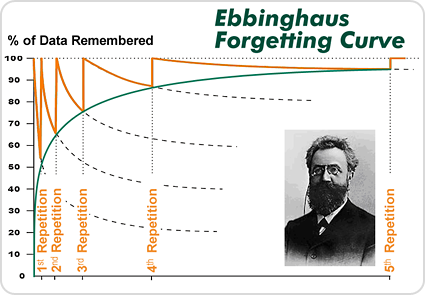
I explained about Ebbinghaus's Forgetting Curve (see PDF). I said that forgetting stuff is good - because we then remember it quicker when we review... but we need to be systematic and regular in that process. They know my advocacy of the CNT method, and how I urge student do have a weekly summary session, and a separate weekly cue column session (and then putting paper over their main notes and testing from summaries and cues). I gave them a reasonably detailed PDF on CNT. I then explained my greatest revision tool... a blank sheet of paper! I asked what they would do when they had written down everything they knew for a particular topic - and every time the answer was look it up! We talked about struggling and practising retrieval. Eventually they would need to add to it (when our 25 minutes was up?) - in a different colour - and then repeat the same task the following week.

3) Keep a Record
I gave them a revision timetable (PDF) but then asked why it has never worked for them. Universally it was because it had gone adrift and then they gave up quickly. I emphasised the need to put to fun stuff on first - Saturday evening Nandos - but also that every day is a new day and if it doesn't work on Tuesday, don't wait until Monday to restart. Yet I offered an alternative - a "work diary" when they needed to record every thing they actually did in a day - like a food diary - and how eye opening it would be. One student came back to me later in the week and said it had been a revelation and upped her productivity overnight. This is also useful so revision can be systematic and all topics covered.

4) Knowledge Organisers
Some teachers make them, and provide them at the start of a unit. At A Level, I use as summaries and students produce themselves. It is always a useful took to work out what is missing - "Why do I have no scholars to put in this box?" "What are the weaknesses of this theory?". I then explained the idea of "Unknown Unknowns":


I encouraged them to get a copy of the exam spec and then highlight only when they had actually found notes in their exercise book on the topic - and do it word by word, not by big statement / topic. I also suggested dating it every time they revised a topic.

5) Cognitive Overload
Are you trying to practice retrieval or are you trying to write a great essay? For students that are struggling, doing both can be tough. Obviously they need to do this in the exam, but we used a 'big game' analogy and discussed David Beckham practising his free kicks for hours the day before the Greece game. Practice the skills separately and build up to the final 'big game' exam.

I added two further documents to their pack:
The last thing I did was urge them to change the narrative. I'm as guilty as most in saying, "It's only 4 months until the exams!". However, the other way is "We have 4 months, that's lots of time to do lots of learning!" - Get that Pomodoro timer set back ready for another 25...


Image courtesy of BBC

Monday, 3 September 2018

Life With A Toddler: Elaborative Interrogation


My son is 2 and a half. He asks a LOT of questions. Most of them begin "How..." or "Why..."

I have frequently mentioned him to my students. He would be an excellent asset to anyone attempting revision. He always wants to know why. These are answers he will no longer accept:

  • "It just is."
  • "Why not?"
  • "Just because."
  • "I don't know."
  • "Does it really matter?"

These are greeted with, "Daddy - don't say that, answer my question please."

Going to Mass is always a great source of questioning. Probably as there is lots of strange things going on, plus the irresistible temptation of me telling him, "You need to be really quiet for this bit. Actually, be silent." 

A few from the last few months include:

  • "Why is Jesus in the round things?"
  • "What actually is the round thing?"
  • "How does the priest say Mass?"
  • "Why is the little circle Jesus?"
  • "Why is Fr Joseph in St Joseph's? And isn't that Joseph?" [Points to statue of St Joseph]
  • "Why do people need the circles to be taken to them when they are sick?"
  • "How does the priest get the circles?"

Even as an RE teacher in a Catholic school, and cradle Catholic, I sometimes struggle. You must also understand that any answer I provide, is then responded to with a further "Why?". Here is one example, to the best of my memory...

  • T: "Why can't I have a round thing?"
  • Me: "You need to be a little older."
  • T: "Why?"
  • Me: "You need to understand what it really is."
  • T: "Why?"
  • Me: "Because it is Jesus, and that's quite complicated."
  • T: "Why is it Jesus?"
  • Me: "Remember the story the priest always tells us, about Jesus and the meal he had with his friends?"
  • T: "Yes... How does the priest make it Jesus?"
  • Me: "That's quite complicated too."
  • T: "Why?"
  • Me: "I'll explain later."
  • T: "No daddy now."
  • Me: "He says a special prayer."
  • T: "Why?"
  • Me: "Because God needs to hear the special prayer."
  • T: "Why does he?"
  • Me: "That's what the Mass is, that's why we come to church."
    • [A few mins quiet]
  • T: "Why do we come to Church?"
  • Me: "To meet Jesus, and meet our friends."
  • T: "Then why can't I have a round thing?"

The good news is, he does remember lots of the information from week to week (spaced and retrieval practice). He does get things confused from time to time - "Look daddy - it's the sick people!" was said far too loudly when the Eucharistic ministers went to collect the Eucharist to take the congregation who were unable to attend Mass.

It's good to ask questions, and I am pleased to have a toddler who wants to know as much as he can. I am also pleased when I see students at lunchtime revising who tell me they are going "Toddler Mode" and irritating each other with "Why?" questions. As I have found out, answering and explaining such questions can be a challenge - even for someone who things they know their stuff!!

Read more on elaboration from the brilliant Learning Scientists here:


-------
Anyway, Mass is sometimes a bit chaotic for me these days. However I took some comfort in this recent article, which I felt compelled to share: A letter to the parents who keep bringing their disruptive kids to Mass, week after week (T is nowhere near this bad, but has been known to repeat the Gospel after the priest if he pauses, and laugh - or shout out "ding ding" after the bell is rung - or go for a wonder...)

Monday, 26 March 2018

How to be a success at A Level


As we embarked on the second cycle of teaching the A Level in Religious Studies, it became apparent that I needed to do more work with my students on the skills that they need to note take, write, learn, review and test. We simply don't do enough of this lower down, and then just expect sixth formers to have some kind of magical transformation over the summer, whereby they somehow can. I feel it has been time well spent, and transferable across other subject areas... 

How to note take

I have introduced, and insisted upon, the Cornell Note Taking system:


See below for how it is used in the reviewing of work. Download Slides <here>. On average it takes 66 days to form a habit... <source> - someone asked what the disadvantage is, I can't work out one. 


How to write

The literacy demands of the new A Level (and GCSE) are far tougher than previously. For Edexcel RS, there are now a variety of different questions types rather than just a 'standard essay' form to learn. As such, I spent a lot of time 'magpie-ing' the best of what I could find to produce a literacy booklet. I get students to read the relevant section before writing an essay - it seems to have helped: 

Download <here>


Charlotte Vardy has also put together a video for RS essays, which can be watched <here>. It is really important to help students know the academic writing forms you want them to produce. Last year I left this too much to chance, or had to try and modify students writing style after they had already formed habits. 

How to learn

We watched this together in class, made notes on each one. We then looked on the Learning Scientists website - <here>. We've also added various resources to our department website <here>. We also have shared resources with parents to make it clear what their son / daughter should be doing - I gave each parent a copy of 10 Rules of Good and Bad studying by Barbara Oakley (adapted by M Smyth) - see <here>.

How to review


The ideal would be to get students to review at least 24-48 hours after a lesson, within a week and again with a month. These are the ideas that I suggested:

  • 24-48 hours: 
    • Add summaries and cue column to Cornell formatted notes - this note taking system forces you to review
    • Re-read lesson Slides on GoogleClasroom and add any further notes, or read from links provided in Slides
    • Watch a summary video to supplement the lesson [Philosophy and Ethics is particularly lucky in this respect - see <here>]

  • A week:
    • Allocate a review period on timetable - ie P3 on a Friday is RS review time
    • Work on a Knowledge Organiser for the topic - use GoogleDocs so it remains a live document that can be added to / ammended
    • Test by covering up main notes and just use summaries and cue column [Cornell], or parts of the Knowledge Organiser.
    • Attempt exam question
    • Use videos or podcasts on website - see see <here> and <here> including a 'method' - not just watching or listening
  • A month
    • Same things as within a week
    • Timetable - calendar it on your phone! 
    • Retrieval practice - start with a blank sheet...
How to test


I frequently talk about their 'unknown unknowns' - what is it they don't know, and how do they know?

We have planned our "Revision Power Hours" - see <here> - as well "The Pomodoro Technique" (25 mins focused, distraction free study, followed by 5 minute break), and the Leitner method for using flashcards.

----------
Hopefully this will help our A Level students, it may also help yours... everyone wants that 'leap in the air' A Level photo in the local press - it could be you!

Thanks to all those who have helped along the way with changing my thinking on this. 

Thursday, 26 October 2017

6th Form Study Skills: Learning & Note Taking


"A man maie well bring a horse to the water, But he can not make him drinke without he will." wrote John Heywood in A Dialogue Conteinyng the Nomber in Effect of all the Prouerbes in the Englishe Tongue. It was true in the 12th Century, and it remains so today. We cannot always get our students to do what we know is best for them, despite telling them over and over.

However, we must continue try, and do it from multiple approaches. I am looking forward to leading some CPD for staff on key principles of 'learning science', I introduce students to the Learning Scientists , I build the principles into lessons through my planning, I write MCQs for our department website and so on. 

I also offered to lead some 6th form assemblies, as I have seen in my own classes that there is a great needed to help students with the demands on the new A Levels. As I made clear to students:

  • You do not start with ‘easy’ material and work towards progressively harder material by the end of Year 13
  • You begin with challenging material, and work with more and more challenging material.
    • You will need to store a vast amount of knowledge in your Long Term Memory.
    • Your Working Memory is relatively small (5 to 7 things), while your Long Term Memory is vast.
    • You need to organise the information into schema in order to access or recall it.
    • You need to adopt a systematic approach to learning, rather leaving it chance.

I then took them on a brief overview of what we know about learning, and how our brains work. I left them with some practical suggestions, including adopting the Cornell Note Taking system. I wished someone had suggested it to me at university or 6th form. It fits with all the other knowledge we have now about effective learning. Why would you not use it? 

Their half term task was to go away and read this... but I will email it to them again next week as a reminder. And I have emailed to all staff to refer to in their lessons. I am going to spend 10 minutes of my first lesson back with 6th form writing CUE at the top of every margin, and drawing a line 5cm above the bottom of their page for summaries. 


There are bits I simplified, this was a 10 minute assembly, not an hour long lecture. However the affirmation I got from a colleague is when he pointed out to the students that it took him 28 years of classroom teaching to work out these principles of effective learning, and now they are pretty much contained in a 6 slide, 10 minute assembly. 

I'm not sure our students realise how lucky they are with what we now know about learning and try to share with them. 

Big thanks to Kim aka The Hectic Teacher and Steve D'Arcy for their help with this presentation

Tuesday, 28 February 2017

Forget Me Not: New GCSE Planning


The new GCSE courses gives us an opportunity to implement more of what we know about how memory works. Even last year, the homework I set for Y11 were tests on Y10 material. A colleague commented that I never set homework based on the work they were doing currently. I asked how they proposed, that a student doing a two year course, would have frequently revisited the material covered 18+ months ago. Her reply was, "I've never thought about it like that."

The Traditional Syllabus (8 units like old and new GCSE in RS)

Study topic A
Test topic A - Give a Working At Grade (WAG) based on study and then immediate test of A
Study topic B
Test topic B - Give a new WAG based on study and then test then immediate test of B, possibly somewhat averaged with A
Study topic C 
Test topic C- Give a new WAG based on study and then test then immediate test of C, possibly somewhat averaged with A/B
Study topic D
Test topic D- Give a new WAG based on study and then test then immediate test of D, possibly somewhat averaged with A/B/C
Y10 Mock - Wonder why student grade doesn't really fit with others WAGs... especially as their results were inconsistent across topics?

Study topic E
Test topic E
Study topic F
Test topic F
Y11 Mock - Often result well below other WAGs... it's the mock what do you expect?
Study topic G
Test topic G
Study topic H
Test topic H
REVISION PANIC
Actual GCSE exam

Topic A was studied in September/October 2015. It was tested in October 2015, June 2016, December 2016 and then in the final GCSE. In many respects this is a reasonable number of revisits.

A New System (2016 onwards)

Study topic A
Test topic A
Study topic B
Test topic A
Study topic C
Test topic A and B
Study topic D
Test topic B and C
Y10 Mock - Test A/B/C/D

Study topic E
Test topic A and D
Study topic F
Test topic B and E
Y11 Mock 
Study topic G
Test topic C and F
Study topic H
Test topic G and H
Actual GCSE exam

Topic A was studied in September/October 2016. It was revisited (via testing) 6 times in the lead up to the actual GCSE (the 7th test).

Context

All units are worth equal marks in the exam, however, some units are worth more in their value to answering other questions. For exam, the key concepts in Topic A (Catholic Beliefs and Teachings) underpin everything else - there is no way I want students to not be familiar with Imago Dei, Creation, Trinity, Incarnation, eschatology. If there is something I want revisiting 6 or 7 times, it is this.

Difficulty

All units are not equally difficult for students. For example, our current students have not studied Judaism since Year 8 (now moved to Year 9) and never at the level we are expecting at GCSE, I feel we need to revisit Judaism more regularly in order they learn key new terminology. 

Flexibility

The above proposed model is flexible. I need to pinpoint which topics need greater revisits. This will determine what is tested when.

Is that it?

No. I am creating multiple choice quizzes (see <here>) and encouraging - with prizes! - for students to do these regularly. GoogleForms also allows me to see where common misconceptions and gaps in knowledge are... for individuals, classes, the year group. The Learning Scientist principles are also being shared with students (see <here>). I am also looking at ways of sharing my understanding of memory with my department. 

How about A-Level?

The huge volume of content at A-Level also demands differing teaching techniques in RS. I have MCQ for 6th form which we do regularly via Socrative and GoogleForms. I admit there is much more work to do here!

Limitations

While acknowledging learning and progress are not neat, tidy and linear this requires adaptive planning. We can plan for a test, but I will need to adapt that test to our needs. It may be that I need to redo tests next year. It may be that different classes need different tests. I also aim to create a full mark scheme for all tests so the following lesson is dedicated to redrafting, 'green pen work' and covering any gaps.

There is a real danger that you create excessive marking. In an ideal world, you could test all content at every test opportunity and it make assessments genuinely cumulative - but this is far too much marking. Selecting key things to test, knowing that review work will be done, will be vital.

Conclusions

The reason I am implementing this to my department is:

  1. More accurate WAGs  - although who knows if our grade boundaries are in any way accurate
  2. Greater use of the principles of spaced learning
  3. Allowing more 'forgetting time' (not testing topic just studied where content may have only be taught the previous lesson!)
  4. Increased learning, not just 'doing' - what is the point of ensuring you cover the content but not ensure the students have learnt key concepts?
  5. Knowledge to underpin skills - the most common reason for not being able to attempt longer essay questions is a lack of knowledge. The quizzes focus on this.
I welcome feedback.


Image courtesy of Pixabay