Last Friday (12th December 2015), I had my second visit to the Department for Education. Last time was to discuss EBT [Evidence Based Teaching] and this time for the #REconsult, a consultation on the new GCSE and A-Levels in Religious Studies. It has been the only such meeting of the 26 consultations that the DfE have conducted to date; in fact the meeting was held twice, during the day and again in the evening for those unable to get out of school.
During the meeting, I tried to make some notes which will hopefully explain some of the process that have been going on. These are my takes on the day and me sharing the information as best I can; I hope any colleagues that were there on the day can help correct or add to me. Please do this via comments at the bottom or via email
TalkingDonkeyRE@gmail.com.
- To address size and suitability of content.
- To ensure appropriate level of challenge.
- To enable progression to further study.
- To review number of optional pathways through the qualification.
- To balance breadth and depth of study.
- To highlight any equality and diversity issues.
Background to GCSE and A Level Reform:
GCSE
In 2013, the Secretary of State for Education, Michael Gove announced the start of the reform process. New qualifications needed to have challenging content with rigorous assessment inline with international expectations. He also highlighted the need to prepare students for further study, and hence the involvement of Higher Education Institutions (HEIs). Gove also wanted these qualifications to be reliable and stretching, yet remain universal and about the same size.
He insisted that there needed to be a high standard set as a good pass (indications are that this will be above a current C). GCSEs should also be comparable across the suite of qualifications. Exams would be at the end of the course with no modules and only very limited use of non-exam assessment (Dance, Drama etc) and tiering.
It was pointed out that Maths and English have set the bar high and we need to match. Many concerns were, and continue to be, raised about the time issue that many schools face with RE. How can the subject be comparable on an hour a week?
A Level
A key focus is that students are better prepared for Higher Education and hence a very heavy involvement from HEIs across all subjects. All courses will all be linear and there is to be a complete decoupling of the AS from the A Level. This will include differences to assessment arrangements so AS marks will not contribute to final A Level grade. It is important that the A-Levels are fit for purpose but will not be harder, as such.
Concerns were raised about timetabling and resources for this. Will AS and A-Level students be in the same class? This was an issue for Awarding Organisations (AOs) to address.
Timetable
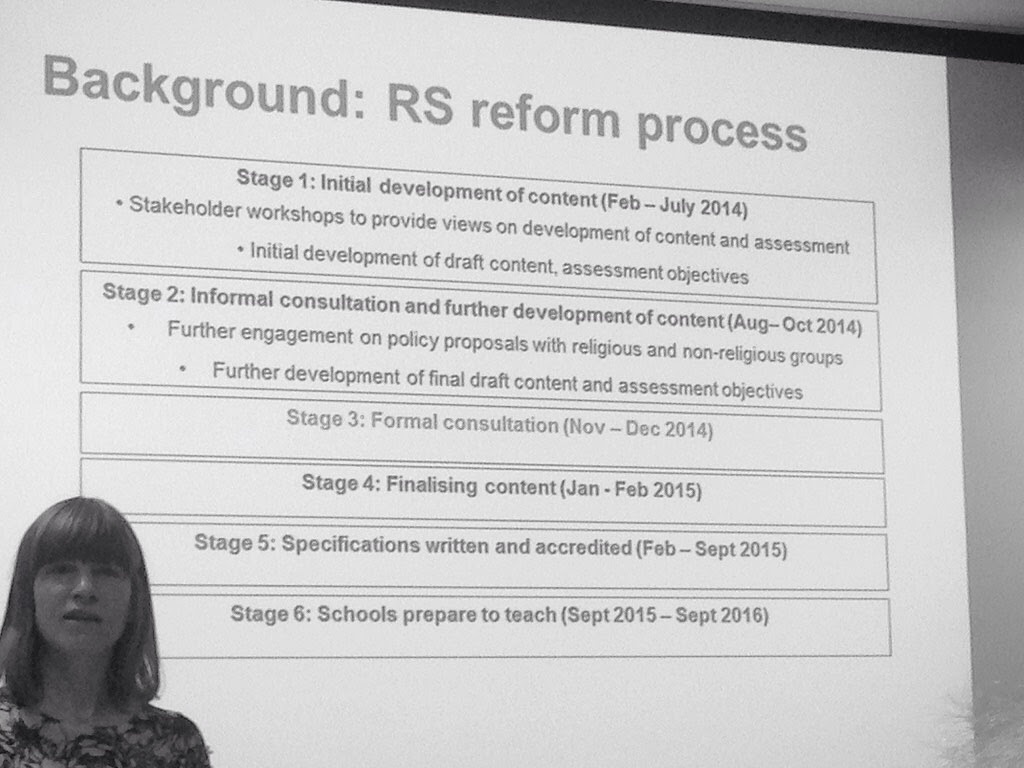
Religious Studies is on track. The content will be published Feburary 2015 and exam specs will be ready by Summer 2015. All GCSEs and A Levels will be fully accredited by Autum 2015 ready for September 2016 teaching. The DfE see this as very important to maintain as they want to launch Religious Studies at the same time as other EBacc subjects.
Some attendees suggested waiting another year to 'get it right', while others seemed to agree that getting parity with other EBacc subjects was better overall. On balance, I think the majority did want 2016. Would you want a student getting all 1 to 9s and then one solitary lettered grade in RS?
Another concern raised, linked to time allocation, was that RS was often studied as a 3 year course. Some mentioned that some schools do ALL GCSEs from Y9. The DfE made it very clear that GCSEs are designed as a 2 year course. They did say that Awarding Organisations (AOs) would be producing Specs from Summer 2015 and so those schools who felt the need, would be able to begin teaching in September 2015, with the rest following in September 2016. Ed Pawson of NATRE pointed out that it was their belief that 30% of schools did early start GCSE RS. Ofqual said there are absolutely no plans for a legacy paper and the last exams of the current GCSE will be in Summer 2017.
Processes for Other Subjects
EBacc subjects were drafted by DfE employed drafters while non-EBacc subjects were divided and lead by the Awarding Organisations. Naturally, all final documents were/are to be approved by ministers. Religious Studies and Citizenship were handed back to the DfE by the AOs due to their diverse stakeholders.
HEIs have played a significant role and a Russell Group Advisory Board have fed heavily into A-Level reform discussion. There is currently a sub-class and super-class of facilitating subjects while the DfE want greater comparability. It was clarified that GCSE RS is in Progress 8.
It was made clear that the DfE have now taken the lead in RS, employing a drafter and engaging with a range of stakeholders. It was noted at the time that Award Organisations should have also been added to this list:

Religious Studies Process
With so many stakeholders, the process obviously took a long time. The DfE worked very closely with the REC in initially to begin informal consultations in February 2014.
Someone questioned whether the process for Religious Studies reform fulfils the Cabinet Office Guidance [2013] and the DfE assured attendees that it does and that those guidelines refer to the process as a whole and not just the formal discussions we are currently engaged in. They are clear that all consultations have been proportionate and that everyone has had an opportunity to voice their concerns and suggestions.
Alongside working with the
REC,
NATRE and
ISRSA were also consulted.
NATRE representatives at the meeting highlighted the fact that they wanted the consultation to be as open as possible from the start. They acknowledged that NATRE cannot reflect every teacher of RE and that the proposals that are currently being consulted upon are not necessarily a reflection of NATREs input.
The DfE pointed out that to date, 12th December 2014, that they had received over 1500 responses since the consultation opened on 7th November. This is probably more than all other 26 consultations that have taken place put together. Some subjects have had less than 50 responses. The DfE are delighted and genuinely overwhelmed by the response of the RE community.
The meeting was the only one of its kind, no other subject had had a meeting, let alone two. The final attendance of these two meetings was around 75 people. Again, it was restated that this was an "unbelievably high level of engagement compared to any other subject".
The time frame for this part of the consultation was slightly on the low side compared to other subjects, but this was a direct reflection of the consultations that had already taken place. It was pointed out that will be a window of 7 and a half weeks, including over a week of school holidays for teachers to make their responses.
The question was asked about what departments were consulted within the HEIs and the DfE assured it was a full range including TRS, Philosophy, RPE, Theology, Religious Studies etc.
The role of ministers was highlighted. Obviously it was noted there has been a new Education Secreaty since the process began, but this has had little effect. Minsters have been very interested and very involved in the RE process, but have wanted the best expert advice too. Nicky Morgan met with religious leaders over the summer, some at the DfE and others she visited in their place of work where necessary. This level of involvement is very unusual. However, it was also noted that a lot of the drive for A-Level came from HEIs.
The editorial team from the DfE will analyse the results of the consultation, alongside their drafter, to produce a final document. It will them be put to the ministers for their approval; they are the ultimate decision makers. Ofqual will need to ensure if meets necessary requirements and the AO chief examiners will be involved. It is unlikely that beyond the consultation period that any teachers will be involved. If, and this is a big if, there was an "overwhelming consensus" in the responses that it is nowhere near ready, it could, hypothetically, be delayed, but this is not something the ministers, the DfE or the editorial team want.
RS Content and Assessment Objectives [Ofqual Lead]
GCSE
We were reminded again that this is a criteria and NOT an exam specification and that final qualifications will look very different. This document sets out the minimum requirements for specifications; these will be set out by AOs including skills for assessment and content. It is also important to remember that this is all taking place in the backdrop of wider reform.
The key concern in RS, and it is also a concern from OFSTED, is focused on the nature of subject and way it is reflected in current form. Currently it is possible to try and engage in debate without knowledge and understanding including that concerned with beliefs and texts. Simply put, there must be more knowledge and understanding of religion [This echo's Alan Brine's 2013 report - see
<here>].
There will be a compulsory element (two religions) and an optional element (textual study or RPE). The key is bring together both common and divergent views in religions, enabling more debate about different views, and investigating one or more views in context of modern world. For example, current content at GCSE doesn't reflect the diversity of traditions and now the Islamic Shi’a tradition will now be included.
The current structure will not be how qualifications will look like, the AOs can combine these ideas in any ways they see fit and could be interwoven by the AOs. However it is important to remember the new Ofqual regulations covering GCSEs and these have been an important consideration from the start and will remain to be so for AOs.
This stresses the importance of people concerned with the future of RE and these qualifications to be approaching the AOs and offering their services. Many AOs are already emailing previous markers and advertising through various media to find the right people. Get involved! Now!
It was stressed that as there are so many stakeholders, life is made very complex. This qualification needs to meet the needs of many people in many very different schoools (for example faith schools; 20% of secondaries are Roman Catholic).
AS/A Level
As a primary aim of the reform (in all subjects) was greater progression from school to higher education, the DfE and Ofqual have taken the views of HEIs very seriously.
At A-Level there were originally 8 areas of study [current format] and it will now be reduced to 3 [new proposals], this was key when drafting. The belief is that there will now be enough breadth to focus on any particular route / branch of Religious Studies at university. However there will still be enough depth of content to meet new rigorous demands of A-Levels.
Due to the decoupling, AS content must be specified.
It is vital that students are provided with critical analysis skills and the ability to debate. This has come from HEIs as they see too many students without these key skills.
Content wise, the start point was the GCSE annexes where texts, religion, religions and P&E are to be covered. However the 6 religions [plus one tradition], was not something necessary or desirable to directly reflect at A-Level. It would have also drastically increased the number of routes to qualification.
It was made clear again, the document being consulted upon is NOT an exam spec. The content is not a list of things you will be studying, AOs will be looking at the content to bring things together in an interesting and engaging way for our students.
Routes / Options [Ofqual Lead]
It was clear that there needed to be tightening up of routes and a means to make explict what the intended routes are for any given qualification. We need to be asking, "what does the journey look like?".
In Religious Studies, there are numerous possible routes, with (currently) LOTS of options. This presents many technical challengees; how do we ensure comparibility? The Ofqual requirement is that any B grade is comparable to any other B grade.
The explicit defining of content is part of this. However admittedly, the answer is not always to add things in. We need to consider what the scope and purpose of GCSE RE is. We need to think about how this translate into specifications?
Just because routes are possible in this current document, doesn't mean it will be in specifications as a possible route. Ofqual are pushing for narrower options, this gives greater comparability and fairness as a result.
A question was asked about how GCSE RE is currently marked, is it criteria or norm referenced? It is neither. Using statisitics, judegments are made so that there is a normative distribution of grades, it does depend on how students react to questions. If a question is poorly answered by all, it is unfair to disadvantage that cohort with what has been potentially a badly phrased question. This will be the process for new GCSE so no student, even in first cohort will be disadvantaged. Additional controls will also be brought in; there will be key anchor points whereby roughly the same percentage of students who get C and above, will get 4 and above. We were told the spread will distribute itself correctly and roughly 20% of those who currently get A will get 9.
There is more on this <here>, which suggests, broadly, the same proportion of students will achieve a grade 7 and above as currently achieve an A and above. For each examination, the top 20 per cent of those who get grade 7 or above will get a grade 9, the very highest performers.
There are the same issues at a level which is something for AOs to address. There will be fewer possible routes, and again, Ofqual see as not a bad thing as better comparability. It is important that when you encounter a student with an A Level grade you can ascertain what they know and what they can do.
There is no "magic number" for routes, but 3 seems to work well. To add a 4th, would add a significant number of extra routes.
From an assessment point of view, it was pointed out that the 40/60 split at AS and 50/50 split at A-Level could cause issues for co-teaching. This was something still in review.
Ultimately they admitted that they won't keep everyone happy at the end of the day.
Overview
The morning was incredibly informative and the people leading session were prepared to have the 'big questions' asked, and had information and answers to hand. Some will be forever skeptical of 'Government' and the DfE, but I felt I trusted the people leading us and they took extensive notes during the day about our comments, questions, objections, fears and criticisms. I feel much better informed of the backdrop in which this consultation document has emerged. Ultimately we remain, rightly or wrongly, at the mercy of the ministers and what the government want RE to look like.
As I've said before, I keep the faith. Good RE will remain Good RE, and it's the Bad RE we all need to keep addressing and challenging!
The rest of the day was spent in smaller groups feeding back on specifics.