Showing posts with label Metacognition. Show all posts

Thursday, 14 February 2019

Top 5 Tips for Exam Success


Ever since reading High Fidelity, I've found Top 5s to be a useful way of navigating life. 

I recently held some tutorials with some groups of 6th form students and thought I would share my Top 5 tips for A Level success. I constructed it around a Top 5 Problems and then a Top 5 Solutions:

Top 5 Problems:
1) Procrastination & Distraction
2) Forgetting Stuff
3) Time Management
4) Insufficient Notes & Resources
5) Cognitive Overload

Rob, Dick and Barry would definitely argue over this list - is it a true list of 5?

Top 5 Solutions
1) Pomodoro Technique
2) Cornell Note Taking
3) Keep a Record
4) Knowledge Organisers
5) Practice in Part

------------------------
So, let's go through the tutorial and explain my rationale. I'm not going to link to everything but I will try give a summary of what I shared with the Year 13 students:

1) Pomodoro Technique
Inspired by hearing Barb Oakley recently, I started the session with my real life tomato timer on the desk. I set it 25 minutes and said that was all we had. I then spoke about how this was devised in the world of work when days run from 9am to 5pm with little structure unlike the school day. I pointed out their weekends, evenings and holidays could be like this. I shared this PDF. After 25 minutes work, you have a 5 minute break. After a few sessions, have a 10 minute break. Obviously phones go in the other room. Always. 20 mins to get back to full focus after a distraction?!

2) Cornell Note Taking
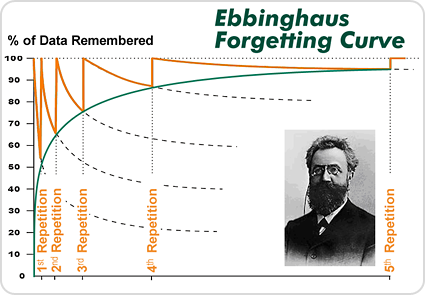
I explained about Ebbinghaus's Forgetting Curve (see PDF). I said that forgetting stuff is good - because we then remember it quicker when we review... but we need to be systematic and regular in that process. They know my advocacy of the CNT method, and how I urge student do have a weekly summary session, and a separate weekly cue column session (and then putting paper over their main notes and testing from summaries and cues). I gave them a reasonably detailed PDF on CNT. I then explained my greatest revision tool... a blank sheet of paper! I asked what they would do when they had written down everything they knew for a particular topic - and every time the answer was look it up! We talked about struggling and practising retrieval. Eventually they would need to add to it (when our 25 minutes was up?) - in a different colour - and then repeat the same task the following week.

3) Keep a Record
I gave them a revision timetable (PDF) but then asked why it has never worked for them. Universally it was because it had gone adrift and then they gave up quickly. I emphasised the need to put to fun stuff on first - Saturday evening Nandos - but also that every day is a new day and if it doesn't work on Tuesday, don't wait until Monday to restart. Yet I offered an alternative - a "work diary" when they needed to record every thing they actually did in a day - like a food diary - and how eye opening it would be. One student came back to me later in the week and said it had been a revelation and upped her productivity overnight. This is also useful so revision can be systematic and all topics covered.

4) Knowledge Organisers
Some teachers make them, and provide them at the start of a unit. At A Level, I use as summaries and students produce themselves. It is always a useful took to work out what is missing - "Why do I have no scholars to put in this box?" "What are the weaknesses of this theory?". I then explained the idea of "Unknown Unknowns":


I encouraged them to get a copy of the exam spec and then highlight only when they had actually found notes in their exercise book on the topic - and do it word by word, not by big statement / topic. I also suggested dating it every time they revised a topic.

5) Cognitive Overload
Are you trying to practice retrieval or are you trying to write a great essay? For students that are struggling, doing both can be tough. Obviously they need to do this in the exam, but we used a 'big game' analogy and discussed David Beckham practising his free kicks for hours the day before the Greece game. Practice the skills separately and build up to the final 'big game' exam.

I added two further documents to their pack:
The last thing I did was urge them to change the narrative. I'm as guilty as most in saying, "It's only 4 months until the exams!". However, the other way is "We have 4 months, that's lots of time to do lots of learning!" - Get that Pomodoro timer set back ready for another 25...


Image courtesy of BBC

Saturday, 8 September 2018

My First Lesson for Y9+ - Teaching Note Taking


An outline of my first lesson:
  1. A brief welcome and hello. 
  2. Seating plan, alphabetically by first name to start with so I get to know names ASAP. Books given out, 10 short rules copied down on the back page. 
  3. Students to use a ruler and create a box at the bottom of each page in their exercise books, 4 lines in size. They do this for 25 pages. 
  4. On the first five pages, they write CUE COLUMN at the top of the margin, and SUMMARY in the bottom box. 
  5. I briefly explain Ebbinghaus’ Forgetting Curve. I then tell them we will be using the Cornell Note Taking system and detail why I think it is the best way to organise their exercise books. 
  6. They are then told the CUE COLUMN is for any key words, names, dates, places - or questions that come to mind. This is be completed at least 24 hours after the lesson - except questions, they can be written in the lesson. 
  7. Next, I inform them that weekly, they will complete the summary boxes and that each page will be summarised with 2 or 3 bullet points. 
  8. We then look at the testing effect - and how that will help them actually securely learn the information. 
  9. I then show them how to use their new note setup to do that - covering main notes, just leaving cues etc. We practice using cues to write short questions. 
  10. I ensure they know to date and title each piece of work. Date so they add further dates for cue, summary, test and review. Title so information is easy to find. 


We then get started learning things...

And the next lesson we begin with a brief test.

(I used to only do this with 6th form, and blogged about that <here> - includes Cornell Slides)

Images courtesy of UMFK and Wikipedia

Monday, 3 September 2018

Life With A Toddler: Elaborative Interrogation


My son is 2 and a half. He asks a LOT of questions. Most of them begin "How..." or "Why..."

I have frequently mentioned him to my students. He would be an excellent asset to anyone attempting revision. He always wants to know why. These are answers he will no longer accept:

  • "It just is."
  • "Why not?"
  • "Just because."
  • "I don't know."
  • "Does it really matter?"

These are greeted with, "Daddy - don't say that, answer my question please."

Going to Mass is always a great source of questioning. Probably as there is lots of strange things going on, plus the irresistible temptation of me telling him, "You need to be really quiet for this bit. Actually, be silent." 

A few from the last few months include:

  • "Why is Jesus in the round things?"
  • "What actually is the round thing?"
  • "How does the priest say Mass?"
  • "Why is the little circle Jesus?"
  • "Why is Fr Joseph in St Joseph's? And isn't that Joseph?" [Points to statue of St Joseph]
  • "Why do people need the circles to be taken to them when they are sick?"
  • "How does the priest get the circles?"

Even as an RE teacher in a Catholic school, and cradle Catholic, I sometimes struggle. You must also understand that any answer I provide, is then responded to with a further "Why?". Here is one example, to the best of my memory...

  • T: "Why can't I have a round thing?"
  • Me: "You need to be a little older."
  • T: "Why?"
  • Me: "You need to understand what it really is."
  • T: "Why?"
  • Me: "Because it is Jesus, and that's quite complicated."
  • T: "Why is it Jesus?"
  • Me: "Remember the story the priest always tells us, about Jesus and the meal he had with his friends?"
  • T: "Yes... How does the priest make it Jesus?"
  • Me: "That's quite complicated too."
  • T: "Why?"
  • Me: "I'll explain later."
  • T: "No daddy now."
  • Me: "He says a special prayer."
  • T: "Why?"
  • Me: "Because God needs to hear the special prayer."
  • T: "Why does he?"
  • Me: "That's what the Mass is, that's why we come to church."
    • [A few mins quiet]
  • T: "Why do we come to Church?"
  • Me: "To meet Jesus, and meet our friends."
  • T: "Then why can't I have a round thing?"

The good news is, he does remember lots of the information from week to week (spaced and retrieval practice). He does get things confused from time to time - "Look daddy - it's the sick people!" was said far too loudly when the Eucharistic ministers went to collect the Eucharist to take the congregation who were unable to attend Mass.

It's good to ask questions, and I am pleased to have a toddler who wants to know as much as he can. I am also pleased when I see students at lunchtime revising who tell me they are going "Toddler Mode" and irritating each other with "Why?" questions. As I have found out, answering and explaining such questions can be a challenge - even for someone who things they know their stuff!!

Read more on elaboration from the brilliant Learning Scientists here:


-------
Anyway, Mass is sometimes a bit chaotic for me these days. However I took some comfort in this recent article, which I felt compelled to share: A letter to the parents who keep bringing their disruptive kids to Mass, week after week (T is nowhere near this bad, but has been known to repeat the Gospel after the priest if he pauses, and laugh - or shout out "ding ding" after the bell is rung - or go for a wonder...)

Monday, 26 March 2018

How to be a success at A Level


As we embarked on the second cycle of teaching the A Level in Religious Studies, it became apparent that I needed to do more work with my students on the skills that they need to note take, write, learn, review and test. We simply don't do enough of this lower down, and then just expect sixth formers to have some kind of magical transformation over the summer, whereby they somehow can. I feel it has been time well spent, and transferable across other subject areas... 

How to note take

I have introduced, and insisted upon, the Cornell Note Taking system:


See below for how it is used in the reviewing of work. Download Slides <here>. On average it takes 66 days to form a habit... <source> - someone asked what the disadvantage is, I can't work out one. 


How to write

The literacy demands of the new A Level (and GCSE) are far tougher than previously. For Edexcel RS, there are now a variety of different questions types rather than just a 'standard essay' form to learn. As such, I spent a lot of time 'magpie-ing' the best of what I could find to produce a literacy booklet. I get students to read the relevant section before writing an essay - it seems to have helped: 

Download <here>


Charlotte Vardy has also put together a video for RS essays, which can be watched <here>. It is really important to help students know the academic writing forms you want them to produce. Last year I left this too much to chance, or had to try and modify students writing style after they had already formed habits. 

How to learn

We watched this together in class, made notes on each one. We then looked on the Learning Scientists website - <here>. We've also added various resources to our department website <here>. We also have shared resources with parents to make it clear what their son / daughter should be doing - I gave each parent a copy of 10 Rules of Good and Bad studying by Barbara Oakley (adapted by M Smyth) - see <here>.

How to review


The ideal would be to get students to review at least 24-48 hours after a lesson, within a week and again with a month. These are the ideas that I suggested:

  • 24-48 hours: 
    • Add summaries and cue column to Cornell formatted notes - this note taking system forces you to review
    • Re-read lesson Slides on GoogleClasroom and add any further notes, or read from links provided in Slides
    • Watch a summary video to supplement the lesson [Philosophy and Ethics is particularly lucky in this respect - see <here>]

  • A week:
    • Allocate a review period on timetable - ie P3 on a Friday is RS review time
    • Work on a Knowledge Organiser for the topic - use GoogleDocs so it remains a live document that can be added to / ammended
    • Test by covering up main notes and just use summaries and cue column [Cornell], or parts of the Knowledge Organiser.
    • Attempt exam question
    • Use videos or podcasts on website - see see <here> and <here> including a 'method' - not just watching or listening
  • A month
    • Same things as within a week
    • Timetable - calendar it on your phone! 
    • Retrieval practice - start with a blank sheet...
How to test


I frequently talk about their 'unknown unknowns' - what is it they don't know, and how do they know?

We have planned our "Revision Power Hours" - see <here> - as well "The Pomodoro Technique" (25 mins focused, distraction free study, followed by 5 minute break), and the Leitner method for using flashcards.

----------
Hopefully this will help our A Level students, it may also help yours... everyone wants that 'leap in the air' A Level photo in the local press - it could be you!

Thanks to all those who have helped along the way with changing my thinking on this. 

Thursday, 26 October 2017

6th Form Study Skills: Learning & Note Taking


"A man maie well bring a horse to the water, But he can not make him drinke without he will." wrote John Heywood in A Dialogue Conteinyng the Nomber in Effect of all the Prouerbes in the Englishe Tongue. It was true in the 12th Century, and it remains so today. We cannot always get our students to do what we know is best for them, despite telling them over and over.

However, we must continue try, and do it from multiple approaches. I am looking forward to leading some CPD for staff on key principles of 'learning science', I introduce students to the Learning Scientists , I build the principles into lessons through my planning, I write MCQs for our department website and so on. 

I also offered to lead some 6th form assemblies, as I have seen in my own classes that there is a great needed to help students with the demands on the new A Levels. As I made clear to students:

  • You do not start with ‘easy’ material and work towards progressively harder material by the end of Year 13
  • You begin with challenging material, and work with more and more challenging material.
    • You will need to store a vast amount of knowledge in your Long Term Memory.
    • Your Working Memory is relatively small (5 to 7 things), while your Long Term Memory is vast.
    • You need to organise the information into schema in order to access or recall it.
    • You need to adopt a systematic approach to learning, rather leaving it chance.

I then took them on a brief overview of what we know about learning, and how our brains work. I left them with some practical suggestions, including adopting the Cornell Note Taking system. I wished someone had suggested it to me at university or 6th form. It fits with all the other knowledge we have now about effective learning. Why would you not use it? 

Their half term task was to go away and read this... but I will email it to them again next week as a reminder. And I have emailed to all staff to refer to in their lessons. I am going to spend 10 minutes of my first lesson back with 6th form writing CUE at the top of every margin, and drawing a line 5cm above the bottom of their page for summaries. 


There are bits I simplified, this was a 10 minute assembly, not an hour long lecture. However the affirmation I got from a colleague is when he pointed out to the students that it took him 28 years of classroom teaching to work out these principles of effective learning, and now they are pretty much contained in a 6 slide, 10 minute assembly. 

I'm not sure our students realise how lucky they are with what we now know about learning and try to share with them. 

Big thanks to Kim aka The Hectic Teacher and Steve D'Arcy for their help with this presentation

Tuesday, 28 February 2017

GoogleForms


"[Dylan] Wiliam’s central point: multiple choice questions can be made to be extremely difficult and challenging, and they can certainly test higher-order learning objectives." Daisy Christodoulou on Principled Assessment Design by Dylan Wiliam

Since moving to a 'Google school', while already being a convert, I have been using GoogleForms extensively since they introduced their new 'quizzing' feature. MCQs that prompt the revisiting of key words, ideas and knowledge can only be a good thing, right?

Workload

These are self marking. You can create a copy of the quiz, set via GoogleClassroom and then copy and paste results into your mark book (in GoogleSheets of course!). I am working on a system for students to record in their books - they often forget! (Does this matter? For whom are they writing in their books? Ofsted...?)

Spaced Learning

All tests are available on our department website (see <here>) we are ensuring regular retrieval practice, and using principles of distributed practice. I am introducing a "Quiz Master" - I will pick a quiz at random each week, the last student who has completed that quiz will get a prize (chocolate).

Informing Planning

I can get insights into what my students know, and what they don't. For example, so far, it is clear they know exactly where Moses received the 10 Commandments, but not the book containing the 613 Mitzvot. This is can be used as a indicator of what areas to focus on. Over time, this could be far more focused. It could also inform what to put on assessments, knowing students will have to review after the test and 'fill the gaps'.


What next for students?

Unlike feedback based on prose, MCQs give instant feedback on what they don't know. They can look up what they got wrong and redo the test. I've found students hate getting less than 10 and will often redo over and over until they get 10.

MCQ Problems
  • Clearly they can't assess everything.
  • They are time consuming to produce (but can be used over and over)
  • Good MCQ are hard to write - there is no point in 'silly' answers
Further reading on MCQs by Daisy Christodoulou
Samples

I have set up all quizzes on our website as being for our students only - they need to be logged in. This is because I want to have data on just my pupils, and so I can see who has completed them! I am sharing a sample here:
I aim to write quizzes for all sections of the new GCSE RS spec (Catholic Christianity, Judaism and P&E Edexcel) and A-Level (Edexcel Philosophy, Ethics and NT). I am willing to share with people who wish to genuinely collaborate.

Forget Me Not: New GCSE Planning


The new GCSE courses gives us an opportunity to implement more of what we know about how memory works. Even last year, the homework I set for Y11 were tests on Y10 material. A colleague commented that I never set homework based on the work they were doing currently. I asked how they proposed, that a student doing a two year course, would have frequently revisited the material covered 18+ months ago. Her reply was, "I've never thought about it like that."

The Traditional Syllabus (8 units like old and new GCSE in RS)

Study topic A
Test topic A - Give a Working At Grade (WAG) based on study and then immediate test of A
Study topic B
Test topic B - Give a new WAG based on study and then test then immediate test of B, possibly somewhat averaged with A
Study topic C 
Test topic C- Give a new WAG based on study and then test then immediate test of C, possibly somewhat averaged with A/B
Study topic D
Test topic D- Give a new WAG based on study and then test then immediate test of D, possibly somewhat averaged with A/B/C
Y10 Mock - Wonder why student grade doesn't really fit with others WAGs... especially as their results were inconsistent across topics?

Study topic E
Test topic E
Study topic F
Test topic F
Y11 Mock - Often result well below other WAGs... it's the mock what do you expect?
Study topic G
Test topic G
Study topic H
Test topic H
REVISION PANIC
Actual GCSE exam

Topic A was studied in September/October 2015. It was tested in October 2015, June 2016, December 2016 and then in the final GCSE. In many respects this is a reasonable number of revisits.

A New System (2016 onwards)

Study topic A
Test topic A
Study topic B
Test topic A
Study topic C
Test topic A and B
Study topic D
Test topic B and C
Y10 Mock - Test A/B/C/D

Study topic E
Test topic A and D
Study topic F
Test topic B and E
Y11 Mock 
Study topic G
Test topic C and F
Study topic H
Test topic G and H
Actual GCSE exam

Topic A was studied in September/October 2016. It was revisited (via testing) 6 times in the lead up to the actual GCSE (the 7th test).

Context

All units are worth equal marks in the exam, however, some units are worth more in their value to answering other questions. For exam, the key concepts in Topic A (Catholic Beliefs and Teachings) underpin everything else - there is no way I want students to not be familiar with Imago Dei, Creation, Trinity, Incarnation, eschatology. If there is something I want revisiting 6 or 7 times, it is this.

Difficulty

All units are not equally difficult for students. For example, our current students have not studied Judaism since Year 8 (now moved to Year 9) and never at the level we are expecting at GCSE, I feel we need to revisit Judaism more regularly in order they learn key new terminology. 

Flexibility

The above proposed model is flexible. I need to pinpoint which topics need greater revisits. This will determine what is tested when.

Is that it?

No. I am creating multiple choice quizzes (see <here>) and encouraging - with prizes! - for students to do these regularly. GoogleForms also allows me to see where common misconceptions and gaps in knowledge are... for individuals, classes, the year group. The Learning Scientist principles are also being shared with students (see <here>). I am also looking at ways of sharing my understanding of memory with my department. 

How about A-Level?

The huge volume of content at A-Level also demands differing teaching techniques in RS. I have MCQ for 6th form which we do regularly via Socrative and GoogleForms. I admit there is much more work to do here!

Limitations

While acknowledging learning and progress are not neat, tidy and linear this requires adaptive planning. We can plan for a test, but I will need to adapt that test to our needs. It may be that I need to redo tests next year. It may be that different classes need different tests. I also aim to create a full mark scheme for all tests so the following lesson is dedicated to redrafting, 'green pen work' and covering any gaps.

There is a real danger that you create excessive marking. In an ideal world, you could test all content at every test opportunity and it make assessments genuinely cumulative - but this is far too much marking. Selecting key things to test, knowing that review work will be done, will be vital.

Conclusions

The reason I am implementing this to my department is:

  1. More accurate WAGs  - although who knows if our grade boundaries are in any way accurate
  2. Greater use of the principles of spaced learning
  3. Allowing more 'forgetting time' (not testing topic just studied where content may have only be taught the previous lesson!)
  4. Increased learning, not just 'doing' - what is the point of ensuring you cover the content but not ensure the students have learnt key concepts?
  5. Knowledge to underpin skills - the most common reason for not being able to attempt longer essay questions is a lack of knowledge. The quizzes focus on this.
I welcome feedback.


Image courtesy of Pixabay

Thursday, 3 November 2016

TMNewham: Lessons from Frank Skinner


I only realised in retrospect that I got my first nugget in meta-cognition from Frank Skinner. A few years ago he spoke about getting old and one of the ways he keeps his brain as active as possible is by imposing a rule of only Googling things he doesn't know, and not what he doesn't remember. This is essentially the practice of memory retrieval, a vital skill for our students. I spoke about this at TM Newham hosted by Jonny Walker at Elmhurst Primary on Thursday 3rd November 2016. 

Here is my presentation:


Wednesday, 26 October 2016

Accessible Research


Teachers are already busy. Calls for a 'research-engaged profession' can fall on deaf ears when there is quite simply already too much to do. At the of a long day, or when there are books to mark or lessons for a new spec to plan, the very last thing a teacher wants to do is start reading research, let alone do anything with it. Equally, even if there was the time, some teachers have no desire to engage with research - if we consider teaching an art, as many do, is this okay? 

Schools should consider carefully how best to impose anything new, particularly something as time consuming as engaging with research. Some schools have appointed specific TLR post holders to filter down the key findings that are useful for teachers. Others have incorporated it into CPD sessions or the appraisal process. This integrated approach may work in some schools, but requires time (again), money and an interest.

I remember David Cameron (not that one) saying at Northern Rocks 2015 along the lines of, "teachers are already spinning lots of plates, we need to work out which are Ikea and which are Wedgewood". If we are adding more, we need to take something away. We can't keep adding more.

Lately on Twitter, I've noticed a few quick wins:

1) Use Chris Moyse's 'Research in 100 words' posters. Download <here>
Put them up around school and rotate:

2) Use the Learning Scientist posters. Download <here>
I made an A5 booklet for 6th formers, I am going to make a display for the corridor and have suggested printing and putting student study booths

3) Share 'The Science of Learning'. Download <here>
In less that 10 pages, staff can have a complete overview of the best we currently know about learning. Cancel a meeting, extend a break time, provide a time to read it

4) Advertise ResearchEd conferences. See <here>
Pay for staff to go - they are on a Saturday!

5) Buy a couple of books for the staffroom/staff toilets. I'd start with <this> and <this>.
And if you can get Nick or David to come and do some INSET

6) Set up a time and space to discuss the opportunities and the challenges. 
Make sure there is free lunch, tea and cake.

For me, we need to work out what makes good teachers good so that we can help others grow to be even better. We know a lot more now that we ever did. Surely it makes sense to try and use it?

“Every teacher needs to improve, not because they are not good enough, but because they can be even better.” Dylan Wiliam

School leaders just need to create and provide the time, space and resources to make it happen.  

Further suggestions received:
1) Join the EBTN <here> [There is a cost...]
2) Sign up to the Best Evidence in Brief email <here> [I don't always find this accessible or practically useful]

Postscript
1) Research should not be elevated to a status above all else
2) Age and wisdom are INVALUABLE 
3) Teaching can never become technocratic - we always have context
4) Pedagogy can never be uniform - we always have context and need individuality 
5) Discussion is always needed to engage with the research - we always have context
6) We always have context
Thank you to Michael Merrick

Image courtesy of Animal Photos

Wednesday, 30 September 2015

The Best Of What We Know...


At any moment in time, that should be our aim.

For too long in education we have accepted 'peddled quackery' and 'snake oil'. Teachers have been mis-sold pseudo-science by companies trying to make an easy buck or SLT looking for a 'silver bullet', found printed on a glossy leaflet.

Thank goodness for people like Dan Willingham, Tom Bennett and the ResearchEd crowd plus the collective power of blogs, Twitter and TeachMeets. We've started to get somewhere far closer to the best of what we know by working collectively and venturing into studies that previously had been ignored by those in education.

This knowledge of how children learn and remember needs to be at the fingertips of all teachers. Thankfully it now can be... A 10 page PDF (with just 6 pages that *really* matter) outlines the best of what we know concisely and in a practical way:


For those already aware of the world of cognitive psychology, there may not be much new here. However the practical explanations are incredibly useful. It also includes an extensive bibliography to take understanding to the next level.

Huge thank you goes to Deans for Impact for this. Some people would try and charge hundreds of pounds to 'sell' these ideas. Thankfully this is being shared freely to help us all become better teachers. It focuses on 6 key questions:

1. How do students understand new ideas?
2. How do students learn and retain new information?
3. How do students solve problems?
4. How does learning transfer to new situations?
5. What motivates students to learn?
6. What are some common misconceptions about how students think and learn?

They used an  brilliant analogy of Messi (Americans talking about soccer!), arguably the world's greatest footballer, when launching this publication:

Lionel Messi is generally considered to be the best professional soccer player in the world, capable of delivering deft passes and jaw-dropping strikes on goal at the highest level of international competition. But does he understand the physics of how soccer balls travel? Perhaps, but color me skeptical. My guess is he’s developed his skills in blissful ignorance of the underlying physical laws that control the movement of the ball.

Perhaps the same holds true for educators – perhaps teachers need not understand the science of learning to be effective. Perhaps teachers, like Lionel Messi, can acquire all the skills they need through deliberate practice without understanding the underlying theory of learning implicit in their actions.   <source>

I agree with David Didau (see <here>), this should be shared with every teacher in the UK. It should also be embedded in all routes of ITT. It should be a key part of CPD. It should not be dismissed as 'something we already do anyway' (do you? do you really?). We really need to share the best of what we know.

How about you starting with those that you know or work with?


Monday, 6 July 2015

#TMIslington: Fighting the Forgetting Curve: My Battle Plan (6/7/15)

Image courtesy of Deuces Cracked

At TM Islington, I shared a 7 minute presentation on embedding some metacognition into my lessons including some 'quick wins' to incorporate into lessons planning. Ultimately we spend a lot of time preparing excellent lessons, but then don't always ensure that students remember them. What can we do to try to improve this?

View on GoogleDocs <here>

Further Reading:
  • Ruth Powley has collated a number of ideas in a recent blog <here>
  • David Didau has just finished a blog series on 20 Principles of Pyschology for teaching <here>
Related Posts:

My KS3 Metacognition handout:

Friday, 12 June 2015

Periscope at HertsSecNATRE


I was very honored to key note the inaugural meeting of the Herts Secondary NATRE Local Group. It was organised off the back of The London RE Hub (see more <here>) by Laura Passmore, Becky Shah, Laura Pope and Flora Richards

It was a fantastic evening, putting a lot of names to faces and sharing some great RE discussion. A note of real thanks must go to Flora's school and students who were amazing hosts. The students were incredibly polite and helpful; they were interested in the event and desperate to look after our every need. Particular note must go to the 'welcoming committee' who were shaking peoples' hands and ensuring I had a chair to "rest my weary legs". The surrounds at Aldenham School were stunning, with hospitality as warm as the weather!

Inspired by Neil McKain, I decided to try and use Periscope for the first time. As Neil has said, he wants more RE documented so it can be shared more widely via Twitter, Save RE, other Local Group meetings etc. This is why were very keen to get all of The London RE Hub filmed too.

First up, I delivered a key note on The Future of RE, similar, but more consise than my presentation to Teach First on Saturday (see here):

Download <here>

You can watch it here:


I then also presented during the TeachMeet section too on some 'quick wins' in RE using metacognition:

Download <here>


Big thanks again to the team for organising, and for inviting me along, I hope I will be able to visit again soon!

Wednesday, 6 May 2015

Accessible Psychology? [KS3]


Image courtesy of A Dad First

Neil Gilbride was arguing on Twitter that the oversimplification of meta-cognition and cognitive psychology could end up as more pseudoscience (cf VAK, Brain Gym etc) - see tweets <here>. He cited a few bloggers who have, by and large, introduced me to these ideas. I admit that they are my main point of reference and I have been very grateful to these people to get me thinking more about my classroom practice and pedagogy. I do see them as an introduction and I want to read and learn more. Sadly, as with many of these things, time really has not allowed it.

Neil argued that teachers should, at the minimum be reading A-Level / Undergrad psychology to fully understand the ideas promoted in the blogs. He recommended the following, which I intend to check out:
It was very odd timing as I was literally in the process of putting together a resource to help my KS3 classes revise. How could I simplify some very complex ideas to a level suitable for 11 year old girls?

I have already done some work with KS4 and KS5 classes, and shared this information publicly <here> and at TM London <here>. As Head of Year, I set some work on it for our PHSE/Study Skills unit, however I made a crucial mistake. Staff were not fully on board as I simply provided the resources without my full rational and explanation (apart from "I think this is really good") and without them necessarily 'buying in'. It is something I need to revisit with my Y10 year group. However I actually spent a whole lesson with my Y11 GCSE RE classes doing the Learning Review I produced (See <here>) and then pointing out key things in my A5 booklet  (See <here>). Some comments were:
  • "This is the best revision session I've ever had."
  • "Why did no one tell us this before?"
  • "I have been wasting so much time."
I decided to try and put the booklet into 15 'easy to read' Tips for KS3; they have their end of year exams coming up. This was hard and impossible to avoid some technical language like memory retrieval and working memory which will need brief explanations. I also wanted to keep the language light, and appealing. However as a result, I do feel it is a little too informal (and bad English?) for a serious resource.

As always, I am very keen for feedback, especially from those who know a lot more about this than me.

Download 15 Revision Tips for KS3 <here> or share http://tiny.cc/15tipsks3

Saturday, 4 April 2015

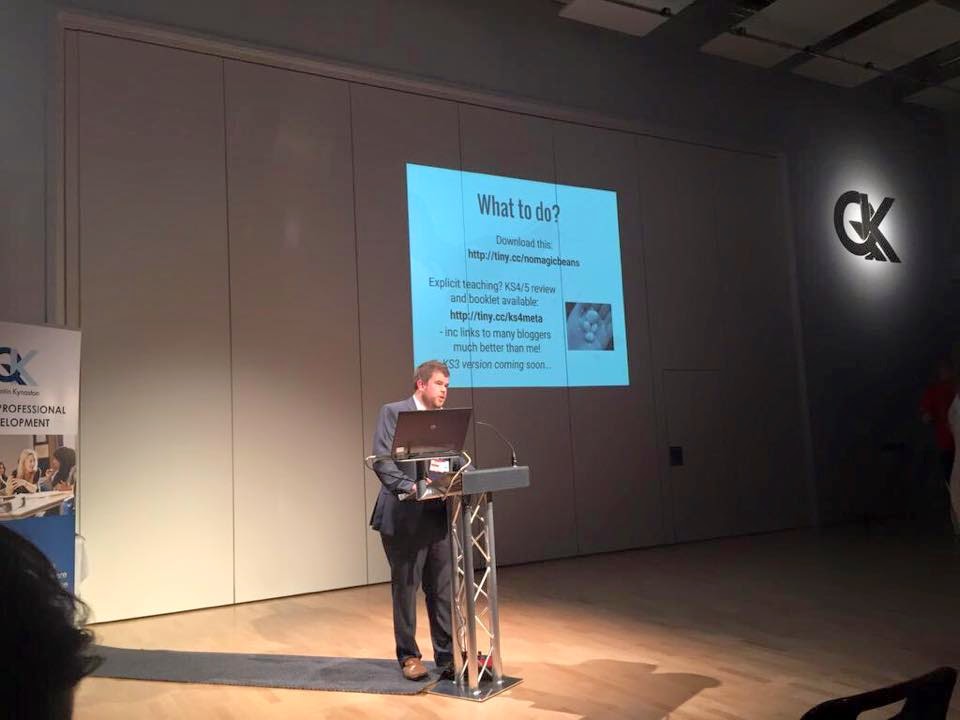
"No Magic Beans" - #TMLondon

Apologies - I can't remember who took this and tweeted it to me!

Thank you to everyone who said kind things about my presentation both via Twitter or in person at #TMLondon. It was a great evening and a real privilege to present and share something with the huge number of colleagues in person and online. Here I will outline what I covered:

Listen <Here>


I have written a blog post about what I am doing with KS4 classes which is <here>. I have done with my Y10 year group (I am Head of Y10) and my two Y11 RE classes... "Why has no-one ever told us this before?" some gasped. I am also looking to do a KS3 version ready for their end of year tests. I hope to sow some seeds of though; they're not magic beans though!

Image thanks to Ben Jose

I also hinted at the fact that meta-cognition / cognitive psychology is NOT a magic beans solution. This is something that Carl Hendrick has recently blogged about <here>. As he says, "to my mind there are four areas in education research: philosophy, anthropology, sociology and of course psychology and at the moment I worry that we seem to have hedged all our bets on the latter."

Somehow I also managed to get a reference in from Frank Skinner, my favourite comedian. A few years ago, he discussed how he tries to ensure that his memory doesn't deteriorate with old age by only Googling things he doesn't know, rather than things he doesn't remember. I think this is particularly important when we have the internet often just a button away....


A few people have said they were surprised by the information on my "Hot or Not" slide. This comes from an article from a number of top cognitive psychologists which can be read <here>. A summary is also available in my student booklet <here>.

Finally, if you fancy watching it again (or indeed for the first time). Check out the video below... fast forward to 37mins:


If you want to read more, see these:


Monday, 2 March 2015

Stop The Madness!

Image courtesy of AV Club taken from the Last Stop: This Town video

At an Eels gig, many years ago, at the Royal Festival Hall, the lead singer Mr E had whipped the crowd into a frenzy. People were on their feet, screaming "I love you E", waving their arms. His reply to calm the lively audience was, "STOP THE MADNESS"! 

This has been the repeated call from a small, but growing, group of teachers in school over the last few years too. STOP THE MADNESS.

This is just some of the MADNESS (read falsities, lies, discredited research...) that still remains in schools, schemes of work, university courses, INSET training:
  • Brain Gym:
  • VAK:

Image courtesy of Systramartha
  • Left Brain / Right Brain: 
Image courtesy of Huffington Post

  • The Learning Pyramid:
Image courtesy of The Peak Performance Centre

  • Thinking Hats:
Image courtesy of TandLHub

Andrew Old wrote a great TOP 10 THINGS TO AVOID IN INSET and these make a few appearances. It's a very worthwhile read <here>. This was indeed published at the start of THIS academic year (2014-2015), not in 2007.

So why, write another blog post on this? It's because despite the absolute discreditation of these things, they still keep cropping up on my Twitter TL and various other professional sources of information that I use. The other day I spent time going through being "the voice of reason" asking people if they knew these ideas were nonsense? Sadly, no one entered into discourse with me, which was probably for the best as I was in a grump and argumentative mood. On first hearing, they also sometimes seem like good ideas; that's why they still exist in some peoples educational thinking.

My interest in "stopping the madness" came when I first came across ResearchEd, which lead me to read Ben Goldacre's DfE paper Building Evidence into Education. If you haven't read this, I strongly urge you do so <here>. He then came to speak at the first Research Ed conference (watch <here>) and the words that stuck with me was the label of much teaching being peddled quackery. By this he meant the pseudo-science found worryingly prevalent in education, often promoted by businesses and training providers who have a vested financial interest. He also meant the way in which teaching has, in the past, not been very evidence based. Tom Bennett refers to it as snake oil (this is a great read <here>).

"If you do what you've always done, you'll get what you've always gotten."

I've found Mark Twain, Henry Ford and Tony Robbins credited with this. Maybe it's another internet-created, made up quote (it just needs an inspirational image in the background, ready to be shared on Instagram; no one ever checks their accuracy either do they?), but the sentiment perhaps is correct. However it does need some further, careful, consideration. If you do do something different, you may get a better result, but you may not. How do you know what will get you a better result? What is your evidence? How do you know?

In December 2013, I was invited to the DfE to take part in some work on EBT (Evidence Based Teaching). This was an interesting evening where a group of teachers offered their thoughts and experience. I had completed my MA and found that the research I had conducted was very meaningful to my practice and I was already considering 'what can I research next?' (and I still am! If anyone fancies funding my PhD, I'm all ears). I chatted to David Laws MP in the lift and he even told me that he "loved EBT".

However the sad reality that was relayed by DfE staff. EBT would be a 10 year project and no minister can undertake a 10 year project... Gove lasted another 8 months and who knows if Nicky Morgan will still be there after the next election. So if not the DfE, then who? As with all the best initiatives, schools and teachers can perhaps do it better than civil servants and those in government office.

I was reminded of this recently when a colleague gave me a flyer in the staffroom with a simple, "You're interested in research, right?". Interestingly it featured Carl Hendrick who I had been chatting to about being a research lead just a few days before over a curry:


Carl works at Wellington College who have embraced the idea of making research useful for staff AND engaging in active research themselves:


Wellington College has launched the first major school-based research centre in the UK, saying that in the future, children should be taught based on what research shows is effective, rather than relying on guesswork, hunches or ideology. [See more  <here>]


Some schools which I have come across that are investing in research leads and active use of research include Huntingdon School under Alex Quigley and more recently Highbury Grove School under the new headship of Tom Sherrington. Perhaps the first I came across was Kev Bartle's Cannons High School encouraging staff to investigate marginal gains? Maybe they will be looked back on as the trailblazers of EBT or whatever it ends up being know as, hopefully just 'teaching'.


'Clinical reasoning' in medicine began in the 1960's after a long period of 'clinical judgement' and an 'art of medicine' whereby decisions depended on individual doctors deciding what evidence, if any, they would consider using to treat a patient. This would be merged with personal beliefs and any number of other varying factors. Clinical reasoning or Evidence-based medicine (EBM) optimises decision making and uses acceptable evidence from well designed research. It highlights epistemological strength and results in only the strongest types being recommended for patient use. It involves meta-analysis, systematic review and RCTs.


I really believe that the mid 2010s will be looked on as a pivotal moment in education. It was the moment where teachers, empowered by the new democracy of the internet, facilitated by Twitter, TeachMeets, ResearchEd conferences / Tom Bennett and Andrew Old curries, said STOP THE MADNESS. 

This obviously needs time and money. These are two things that most schools do not have. Equally individual teachers are, generally speaking, on their knees, all the time. It is hard to find time to read, let alone undertake, research. When I did my MA, I pretty much had to give up Sundays and all my holidays. To undertake research with my current workload would undeniably shift my work-life balance the wrong way (and hence me abandoning my NPQML). However as previously mentioned, some schools are managing to find the time and money as part of a CPD and school improvement programme. Who's next?

Some recent blog posts on using research in schools:

"Why should teachers engage with, and in, research?" by Sara Stafford (Director of Research at Highbury Grove School)
A valuable post that explains concisely, and with diagrams, what a school director of research does and how the school are going to use research to be a 'praxis' that transforms practice by engaging with and in research. Read it <here>

"4 ways to use evidence in education - and 15 places to start" by Harry Fletcher-Wood  (History teacher and Teach First researcher)
Harry gives 4 straight forward ways in which schools and staff can use research, He then gives some links to some great starting points. Read it <here>

"Why every school needs a research champion" By Carl Hendrick, (Head of Learning and Research, Wellington College)
A useful overview on what a research champion is and why they are important; 7 clear reasons are provided. Read it <here>

"50 shades of uncertainty in educational research" by Jane Pettifer 
Some key questions asked and answered about using educational research. Read it <here>

There is also a new Journal for Applied Education Research which looks like it will be worth investigating. It promises "Peer led, classroom focused education research". Find out more <here>


Research Ed: "Working Out What Works" - the website <here>